Charles Severance wrote an interesting post on his weblog. He reflects on the status of Sakai (the product, the community, the maturity etc), in relation to the attention that was given to Sakai during the last three annual Educause conferences.
In essence Chuck concludes that we have become just one the options within the playing field. Just saying that Sakai is opensource doesn't win any contract any more. Check out Dr. Chuck's Web Log: Status Update: "So I take the occasion of Educause to reflect on things to make sure that I remain grounded in what we are doing and why we are all here."
Here is my little reflection on the status of Sakai. The time is now to indeed change some things: more emphasis on communication (or 'marketing') is one of the things that is on the top of my mind. But also the pure product information on Sakai (what is available? in which version of Sakai?) should be readily available. Quite a few of the questions that were asked during my presentation and demo (text is in Dutch, but presentation is in English) at the Tilburg University yesterday were exactly of this nature. For example: "There is no versioning capability within the Resources tool? How can we then seriously consider Sakai? Blackboard already has versioning, and this is a requirement for us!" Fortunately I could answer that in Sakai 2.4 we will have versioning. But how sure is this answer?
I guess, maybe, just maybe, we should have some sort of product manager role within the community that really can take responsibility for the product releases... My impression is that we still let releases happen too much dependant on the availability of developer resources. Just my 2 cents...
If you have some more spare time, then I would recommend to start reading the great conversation developing on the Sakai dev list on the 'need' for a 'community roadmap'. Check out the public version of this thread.
dinsdag, november 28, 2006

vrijdag, november 24, 2006
Sakai SIG NL at the Podium
Today I have presented for the Podium group of ICT experts of 7 different institutions in The Netherlands (University of Utrecht, University of Maastricht, Wageningen University and Research Centre, Free University of Amsterdam, Leiden University, University of Groningen, University of Twente). There were very relevant questions by the audience. One of the most prominent ones: "How do you go about with migration from Blackboard to Sakai (or any other VLE)?" I have referred to Confluence.
Check out the attachment at Sakai op het Podium, if you are interested. Next Monday I will be doing a reprise, based on the same presentation, at the Tilburg University.
Check out the attachment at Sakai op het Podium, if you are interested. Next Monday I will be doing a reprise, based on the same presentation, at the Tilburg University.
woensdag, november 22, 2006
We had a great meeting today!
Today we had our 3rd face-to-face meeting of the Sakai Special Interest Group The Netherlands (Sakai SIG NL). We had quite a bunch of new people at the table, which is great. We even had some Belgian collegues from Gent. There were some great stories and experiences that were shared. I was pleasantly surprised by the great number of institutions that are working with OSP, mainly due to the efforts of Portfolio4U.
I have tried to capture most of the meeting in the notes. Check the website for all the nitty gritty details. I am awaiting eagerly the stuff that Jaeques and Ferry shared with us :-)
For (y)our convenience here are some URL's that were mentioned today:
I have tried to capture most of the meeting in the notes. Check the website for all the nitty gritty details. I am awaiting eagerly the stuff that Jaeques and Ferry shared with us :-)
For (y)our convenience here are some URL's that were mentioned today:
- Translation of Sakai into Dutch: http://issues.sakaiproject.org/confluence/x/7W4
- Overview of all QA servers to be found on http://issues.sakaiproject.org/confluence/x/ZT8
- Styleguide for the Dutch translation: http://issues.sakaiproject.org/confluence/x/8G4
- Our wiki: http://www.sakai-pilot.utwente.nl/sakaiwiki/
- Video Alfa College (featuring Jim Doherty): http://video.google.com/videoplay?docid=3462508180886557891
vrijdag, november 17, 2006
Sakai SIG NL: Agenda for 22 november 2006
{Dutch} Iedereen is welkom op 22 november 2006 in Utrecht. Agenda voor 22 november 2006: "De agenda voor onze derde bijeenkomst is bekend. Zie het attachment. We hebben een aantal nieuwe gezichten aan tafel en er is een interessante bijdrage van Walter Brand (Memotrainer)."
donderdag, november 16, 2006
SURF Onderwijsdagen 2006: Sakai stuff
The last two days have been quite busy for me, as I was visiting the SURF Onderwijsdagen, the largest conference and tradefair regarding ICT in Education in The Netherlands.
I had tried to prepare myself properly with regard to sessions that I would like to participate in, but this proved quite difficult because of the clumsiness of the conference website. And during the conference the sort of same feeling struck me: so many people, the lack of food during lunchtime, the very crowded trade floor and the heat in some of the conference rooms! Maybe the conference needs a different format.
Anyway, this blog is about Sakai in The Netherlands! I had some interesting conversations with regard to this subject during the conference. Let me share with you some new insights and interesting developments.
First of all I had a chat with a representative of Dokeos Nederland. This was after the very interesting presentation by the Vrije Universiteit Brussels (in Belgium). They have implemented the Dokeos course management system (opensource ofcourse) and have formed a large consortium with mainly Belgian partners, but also partners in Chile, Spain and France, to sustain developments for Dokeos. This reminds me a little of the Sakai Foundation, although there are major differences regarding governance I think. And ofcourse the scale is much smaller. To the best of my information some of the institutions on the partnerlist are also using (of have used or evaluated) Sakai and/or OSP.
Then I talked a while with a representative of a large community college who just have dediced to go with Sakai. Great news!
And thirdly I got introduced to a university in Belgium, that is using WebCT right now. They are very keen to get more insight in the possible alternatives. And since there is quite an active opensource movement in Belgium, they are seriously considering Sakai and other opensource systems.
vrijdag, november 10, 2006
OSP within the Netherlands
OSP (Open Source Portfolio) might be relatively unknown, but sometimes you can read something about it, even within The Netherlands. There are two things I would like to point to. [what follows is partly in Dutch]
1. Zo schrijft Wilfred Rubens: Ervaringen met eportfolio bij Gilde Opleidingen: "Na een selectieprocedure is gekozen voor Open Source Portfolio (OSP), dat geïntegreerd is binnen Sakai. Gilde Opleidingen heeft ook binnen OSP een web-based formulier gemaakt dat deelnemers moet aanzetten tot reflecties."
2. Jim Doherty (Portfolio4U) has been interviewed by Chuck Severance regarding their experiences with OSP. I hope to see the video real soon!
donderdag, november 09, 2006
{Dutch} Ga je stemmen of kom je naar Utrecht?
De uitnodiging die ik het gemaild naar iedereen waarvan ik veronderstel dat ze enig belang zouden hebben om op 22 november aanwezig te zijn. Ook lezers van dit weblog (die de mail niet hebben ontvangen), mogen mij mailen of ze gaan komen!
================
From: Koopal, W.Y. (Wytze, ITBE)
Sent: Thursday, November 09, 2006 10:10 AM
To: {removed}
Subject: [Sakai SIG NL] Ga je stemmen of kom je naar Utrecht?
Hallo mensen,
De tijd schrijdt voort. Het is herfst geworden. Volgende week zijn de SURF Onderwijsdagen. Op 22 november gaan we stemmen voor een nieuwe Tweede Kamer.
Maar he, wat zien we daar in onze agenda's staan? Op 22 november is ook de derde bijeenkomst van Sakai SIG NL. Ik hoop dat deze datum ook in jullie agenda's is terecht gekomen. Zo niet, dan hierbij de herinnering!
Op 22 november zullen we in ieder geval 1 of 2 praktijkverhalen gaan horen mbt het gebruik van Sakai. De agenda voor 22 november begint dus vorm te krijgen. Het 'rondje langs de velden' is natuurlijk ook een agendapunt, evenals een staande lunch. De definitieve agenda zal uiterlijk op 16 november op onze website (elearning.surf.nl/sakai_nl) verschijnen.
Graag hoor ik via een kort antwoord (svp voor 14 november) op deze email of je ook van plan bent te gaan komen op 22 november.
Regards,
Wytze Koopal
University of Twente
SURF Sakai community manager, The Netherlands
=============
dinsdag, november 07, 2006
Must-reads on Sakai
On our website (of the Sakai SIG NL), I have created a short message (in Dutch) a few days ago with links to three important documents regarding Sakai.
The most readable (at least for me) is the document that Charles Severance wrote with Joseph Hardin, entitled "Strategic Directions for Sakai and Data Interoperability". (direct link)
The most readable (at least for me) is the document that Charles Severance wrote with Joseph Hardin, entitled "Strategic Directions for Sakai and Data Interoperability". (direct link)
vrijdag, november 03, 2006
Sakai 2.3.0 is available!
Today, Nov 3 (2006), Sakai 2.3.0 has been officially released!
Sakai 2.3.0 is the first release to promote successful provisional tools to the enterprise bundle (Rwiki and Calendar Summary). It also includes three new provisional tools. Sakai 2.3 introduces a significant number of feature enhancements to existing tools as well, along with over 450 fixes. See the release notes for more details. You can also download a Sakai Demo
Sakai has not yet been thoroughly tested with either Firefox 2.0 or IE7, though early testing has not revealed any issues.
vrijdag, oktober 27, 2006
Who is going to / Wie gaat er naar Atlanta?
It would be nice to have some idea which Dutch collegues are going to Atlanta for the 6th Sakai Conference. Please respond by commenting on this post. You can also send an email to Wytze in case you don't want to be known :-).
I am planning to have the following travel schedule (nothing final yet):
To Atlanta on Monday 4 dec, KL621
To Amsterdam on Friday 9 dec, KL9289 and then KL644 (via JFK)
Disclaimer: this is just for informative purposes... I am not going to act as your travel agent!
Tags: travel, atlanta, conference, sakai
woensdag, oktober 25, 2006
Candidates for Sakai Foundation Board published
Candidates for the 2006 Sakai Foundation Board election have been announced today. You can view the candidates bios and statements at https://sakaiproject.org/election. Board members will be elected by the institutional and corporate representatives as specified in the Sakai Foundation bylaws. These are the candidates (names link to their bios and statements about their candidacy and vision for Sakai): Lois Brooks , Michael Feldstein ,Clay Fenlason ,Rolf Granow, Joseph Hardin, Michael Korcuska, Deon van der Merwe.
This list shows some very very well respected people (at least by me!), as well as that Sakai is really international (Rolf Granow is from Germany and Deon van der Merwe is from South Africa).
This list shows some very very well respected people (at least by me!), as well as that Sakai is really international (Rolf Granow is from Germany and Deon van der Merwe is from South Africa).
woensdag, oktober 18, 2006
WebCT versus Sakai? Read this!
During my travels around the web, I sometimes find some interesting treasures. A few months ago I found the UBC Arts ISIT Learning Tools Community Blog. I cannot really find out who the authors are, which is a pity. I guess that UBC stands for University of British Columbia.
Because they use categories on their blog it is quite simple to point you to all relevant posts on this blog that give you some insight in differences between WebCT and Sakai as seen through the eyes of an enduser. Just go to UBC Arts ISIT Learning Tools Community Blog - WebCT versus Sakai.
Because they use categories on their blog it is quite simple to point you to all relevant posts on this blog that give you some insight in differences between WebCT and Sakai as seen through the eyes of an enduser. Just go to UBC Arts ISIT Learning Tools Community Blog - WebCT versus Sakai.
vrijdag, oktober 13, 2006
Interviewing in Dallas
Every year a large group of Dutch elearning professionals visits the annual Educause conference somewhere in the US. This year the group traveled to Dallas. Keith Russell (University of Utrecht) got hold of Charles Severance and conducted an interview for the Edutrip 2006 weblog which also has been recorded.
Thanking Keith for pointing this out for us.
Thanking Keith for pointing this out for us.
woensdag, oktober 11, 2006
Interdisciplinary studies (UvA) supported by Sakai
By:
- Jaeques Koeman, Universiteit van Amsterdam (IIS), Edia
- Roland Groen, Edia
The Sakai implementation www.iis-communities.nl is the learning environment for interdisciplinary lecture series at the Institute for Interdisciplinary Studies (IIS, www.iis.uva.nl) of the Universiteit van Amsterdam. A broad population of students including alumni, contract students and students at other universities participate in these lecture series, which cover topics ranging from conflict studies, religion, quantum lessons and China.
The use of Sakai in supporting the lecture series offered ways to overcome bottlenecks and meet new demands and opportunities at the same time. The environment has been configured to meet demands such as facilitating experts at distance to contribute to the educational process and have a level of public accessibility to allow the communication and transfer of academic knowledge to a broader audience outside the university. By doing this, the achievements made during these lecture series (e.g. a Wiki containing future scenario’s about the city of Amsterdam) will also not be deleted at the series’end, but remain publicly accessible and serve as a reference point for future students, thus creating a community around interdisciplinary topics.
The Sakai implementation www.iis-communities.nl was done by Edia - education technology (www.edia.nl) . Edia is an Amsterdam-based company that develops educational software, implements (open source) e-learning technologies and advises in the field of ict in (higher) education. Since 2005 Edia has monitored the developments of Sakai and now has version 2.2.1 in production at IIS. Next to adding various bug and issue reports and some translation work, Edia has developed a tool for versions 2.1.1 and 2.2.1 that combines the register, join and login functions in one.
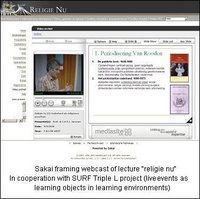
Both Edia and IIS are now joining forces with the Computing Centre of the Universiteit van Amsterdam, exchanging experience and ideas on applications of Sakai within the university. For example, 2007 will see Sakai in action supporting online academic introduction courses for scholars (Webklassen).
- Jaeques Koeman, Universiteit van Amsterdam (IIS), Edia
- Roland Groen, Edia
The Sakai implementation www.iis-communities.nl is the learning environment for interdisciplinary lecture series at the Institute for Interdisciplinary Studies (IIS, www.iis.uva.nl) of the Universiteit van Amsterdam. A broad population of students including alumni, contract students and students at other universities participate in these lecture series, which cover topics ranging from conflict studies, religion, quantum lessons and China.
The use of Sakai in supporting the lecture series offered ways to overcome bottlenecks and meet new demands and opportunities at the same time. The environment has been configured to meet demands such as facilitating experts at distance to contribute to the educational process and have a level of public accessibility to allow the communication and transfer of academic knowledge to a broader audience outside the university. By doing this, the achievements made during these lecture series (e.g. a Wiki containing future scenario’s about the city of Amsterdam) will also not be deleted at the series’end, but remain publicly accessible and serve as a reference point for future students, thus creating a community around interdisciplinary topics.
The Sakai implementation www.iis-communities.nl was done by Edia - education technology (www.edia.nl) . Edia is an Amsterdam-based company that develops educational software, implements (open source) e-learning technologies and advises in the field of ict in (higher) education. Since 2005 Edia has monitored the developments of Sakai and now has version 2.2.1 in production at IIS. Next to adding various bug and issue reports and some translation work, Edia has developed a tool for versions 2.1.1 and 2.2.1 that combines the register, join and login functions in one.

Both Edia and IIS are now joining forces with the Computing Centre of the Universiteit van Amsterdam, exchanging experience and ideas on applications of Sakai within the university. For example, 2007 will see Sakai in action supporting online academic introduction courses for scholars (Webklassen).
zaterdag, september 30, 2006
Anonymous browsing in Sakai
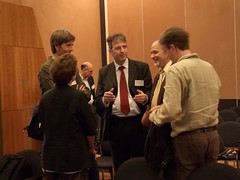
Last Thursday Charles Severance was one of the keynote speakers at the "Over de grenzen van de ELO" conference, where Stanley already reported about in this blog. His official announcement of the 7th Sakai conference to be held in Amsterdam, next June, was great news!!
But there was more news than that of course. I will share two news items with you. I have some more, but i am not able to share them here.
The first newsitem newsworthy item was spawned by Keith Russell of the University of Utrecht (mentioned earlier on this blog), who raised the question of anonymous use of Sakai during the Q&A session with Chuck. The answer by Chuck was very clear: in the near future it will be possible that (part of) a course or project site can be made public. That is: you could make the Announcements public, so for everyone to read (including Google!), but the rest of your tools in Sakai private (so only for site members). See Jira for more details on Google indexing. This feature would really be an great improvement for Sakai. Actually we have exactly the same problem with our current VLE.
One other newsitem (from the hallways) is that one of the larger institutions for vocational education in The Netherlands will start piloting with Sakai real soon.
If you want to read more on "Over de grenzen van de ELO" conference, please go to Wilfred Rubens (in Dutch) or Marc Dupuis (in English) or Scott Wilson (one of the other excellent keynotes that we were offered!) And maybe Willem van Valkenburg will be ready to share some comment with us, once the VVD congress is over :-)
More pictures at Flickr
vrijdag, september 29, 2006
Sakai Foundation present at Dutch ELO Conference
The Dutch conference "Over de grenzen van de ELO II" (Beyond the boundaries of the electronic learning environment), held on Sept. 28th-29th, included two interesting contributions made by Chuck Severance, Executive Director of the Sakai Foundation. See http://stanleyportier.blogspot.com for a reflection of the first conference day.
Sakai Announces June 2007 Amsterdam Conference
The Sakai Foundation is pleased to announce that the June 2007 Sakai Community Conference will be held in Amsterdam, The Netherlands. The dates will be Tuesday -Thursday, June 12-14, with pre and post conference sessions and activities on Monday the 11th, and Friday, the 15th. This will be the first European venue for the Sakai Community Conference and we look forward to working with all our community and especially the Universiteit van Amsterdam on the conference. The site will be the new Movenpick Hotel Amsterdam City Center for the Tuesday-Thursday meetings. See you in Atlanta this December, and Amsterdam next June.
- Joseph Hardin, Sakai Conference Chair
The Universiteit van Amsterdam and the City of Amsterdam are very pleased that Amsterdam will host the Sakai 2007 June conference. The university will work closely with the Sakai Foundation and the Sakai Community to make the meeting a huge success. The conference itself is happening in one of the most modern buildings of Amsterdam in an astonishing setting on the waterfront, next to the canal area and the city center, and we intend to host the pre- and post- conference meetings in university buildings in the historic center. The open cosmopolitan spirit of Amsterdam fits perfectly with the open source spirit of the Sakai community.
- Frank Benneker, Universiteit van Amsterdam
maandag, september 25, 2006
Keith's take at Sakai 2.2
Keith Russell (University of Utrecht) contacted me a few weeks ago. I provided him with some testing oppurtunities on our Sakai pilot installation. He quite hits the right spots, I think, in his review: "I had a go at the new version of SAKAI (2.2.0) which was so kindly provided by Wytze Koopal. It was very interesting to give it a go and I learnt a number of new things. So here a quick resume..." I left some comments on his weblog.
Keith will co-lead the Dutch delegation to the upcoming Educause annual conference in Dallas, with a special emphasis on coursemanagement systems. Check out the wiki of this Dutch bunch for the different themes that they will be focusing on. They also have a weblog. Both the wiki and the weblog are in Dutch btw.
Keith will co-lead the Dutch delegation to the upcoming Educause annual conference in Dallas, with a special emphasis on coursemanagement systems. Check out the wiki of this Dutch bunch for the different themes that they will be focusing on. They also have a weblog. Both the wiki and the weblog are in Dutch btw.
donderdag, september 21, 2006
Shift towards multi-channel learning
The september poll by Brandon-hall.c0m shows that 78% of the respondents predict a further shift towards a multi-channel learning paradigm. Multi-channel as an alternative for the traditional tell-test model of e-learning. Even the definition of "content" becomes broader as in any online experience or task that leads to learning (Woodill & Brandon Hall Research, 2006). The focus is now on mental models through the cooperative an collaborative construction of knowledge based on discussion and guided exploration (Jochems et al., 2004). Provided that this is the educational development mainstream for the next couple of years, I think this provides excellent possibilities for Sakai. As stated in Luebeck - two weeks ago- especially the collaborative and groupware functions are considered USP's in Sakai, which perfectly matches with current and future educational paradigms.
References
Jochems, W., Merrienboer, J., and Koper, R. (Eds.) (2004). Integrated E-learning: Implications for pedagogy, technology and organization. London: Routledge Falmer.
References
Jochems, W., Merrienboer, J., and Koper, R. (Eds.) (2004). Integrated E-learning: Implications for pedagogy, technology and organization. London: Routledge Falmer.
vrijdag, september 15, 2006
Check out Planet Sakai!
While in Luebeck i heard the newest buzz! It is called Planet Sakai. And Steve Githens is THE driving f0rce behind it and has just released it 'officially. He says: "Planet Sakai is a wonderful world of aggregated camaraderie amongst Sakai users, coders, pedagogy folks, admins, etc etc."
So check it out at http://www.planetsakai.org ! (and yes, this weblog gets aggregated too!).
So check it out at http://www.planetsakai.org ! (and yes, this weblog gets aggregated too!).
donderdag, september 14, 2006
Meeting notes available
Yesterday we had our second official meeting of the Sakai SIG NL. I was pleasantly surprised to see some new faces at the table (well actually this is what I am aiming at ofcourse!). We heard some great stories about Sakai. I have tried to capture anything of interest in the meeting notes (that are in English, for our non-Dutch speaking friends around the world).
Sakai SIG NL: Verslag 13 sep (editie 2): "Op 13 september was de tweede officiële bijeenkomst van de Sakai Special Interest Group NL. Het was een interessante bijeenkomst met nieuwe en bekende gezichten.
Het verslag is te vinden in de bijlage. Volgende bijeenkomst is gepland op 22 november 2006. Iedereen met interesse in Sakai is van harte welkom."
dinsdag, september 12, 2006
Pedagogy, education or...
During the European Sakai Days I noticed that the term pedagogy was mentioned a few times. Personally, I believe this is not the best concept to use in the Sakai context. Although it is nowadays used in a broader context, the emphasis is still on teaching children. Moreover, pedagogy includes a lot more issues about raising children from birth till they are adults. I have another reason not to prefer pedagogy instead of concepts like education, learning or didactics. In the context of education, pedagogy is most times referred to as the correct use of teaching strategies or the science of teaching, i.e. the teacher is in control. However, in the context of Sakai and the Bologna issues the focus is on learning. The educational process becomes demand driven: the student is in control of his own learning process. Collaboration and groupwork are key issues. How to organise groupwork is not a matter of pedagogy but of educational or learning design.
zondag, september 10, 2006
Further Luebeck impressions
In addition to the posts that were already submitted by Frank and Wytze, for me it was a key issue (e.g. explicitly stated by Rolf Granow and confirmed by Chuck Severance) that the focus within the Sakai community should now shift from the development approach to the user approach. The learners and instructor are the real stakeholders, although development should continue for further improvement of Sakai. Perhaps the European partners should take a lead in this. I think this approach fits perfectly well within the approach we have taken in Twente: starting with the educational user requirements and then see how ICT can facilitate.
I had an interesting talk with John Norman, right after my own presentation. It comes down to an offer by Cambridge to help with the startup of a development workflow process. What issues do you have to deal with when starting up, how to deal with requirement lists, releases, setting priorities, deployment to the community are some aspects that could be addressed. The Cambridge people are willing to come over if we like. It may also be considered to relate this to a possible development group within the Dutch SURF Sakai SIG.
A third point which became clear to me is that there's a market for commercial affiliates. Several people I talked to are interested in using Sakai, but simply don’t have the expertise for development and support capacity within their own resources. Hosted solutions (based on major releases), integration with existing infrastructure (e.g. student administration), implementation support and helpdesk are a few services that would help out to make these organisations use Sakai. It's good if organisations would join the community on that basis, because it's important for the future of Sakai to have as much as possible a large install base.
For further impressions by the CBUS team from Twente look at: http://www.sakai-pilot.utwente.nl/sakaiwiki/lubeck_impressions
vrijdag, september 08, 2006
Oslo and Stockholm
Oslo and Stockholm where the universities that sent out very thought-provoking (and excellent English-speaking) presenters for the first European Sakai Days (ESD). Susanne Koch from Oslo University talked about three tasks that we have as the Europeans within the worldwide Sakai community:
1. Identify European challenges and ideas about pedagogy and education; these can be derived from the Bologna process and EU's Lisbon process
2. Ask ourselves seriously: "Does the Sakai framework currently or potentially help us better than, say, Blackboard, and why?" So, for example how well does Sakai support lifelong learning and other things.
3. And if and when the previous questions are answered positively, then we should ask ourselves: "How do we format, maintain and cultivate the network?" One thing that Susanne mentioned (and that was also said at our Euro BOF in Vancouver), was that we could try to apply for EU funding. The complete presentation by Susanne can be found online.
And after this very interesting talk by Susanne, there was even a more interesting one by Frerik Oldsjö from Stockholm University. He really gave us a thorough insight in the Bologna process and the pedogical implications. Fredrik made very clear that the Bologna process will result in a pedagogical shift in our educational systems for higher ed! The purpose of Bologna process (which started in 1998) is to create one European Area of Higher Education (EHEA). And don't be fooled: this is not a EU endeavour. The Bologna process has been ratified by 45 European countries! There are ten operational goals, all revolving around comparability, compatibility and transparancy of the systems for Higher Education.
One of the most mindboggling things that I heard is that this whole process essentially means that there should be focus on learning outcomes and assessing these, instead of content. Or take this consequence: much more focus on (peer) feedback!
Fredrik very neatly had translated the Bologna process into some basic requirements for a VLE / LMS or CMS:
1/ should at all times be possible to have an open dialogue over time
2/ full integration of online and offline activities
3/ discussion / dialogue between all involved
4/ summative and formative assessment -> combine in portfolio, but also basic simple assessment tools (!)
5/ seperate group discussions (threads, visual structure), fora, blogs, chat etc
6/ inspiring and secure (socialization): they need to get to know their peers, present themselves to the group
7/ the teacher (the tutor) should have tools that allow for getting a picture of the learning process.
Fredrik's presentation will be online shortly hereafter. I recommend it!
So, all in all I really liked both contributions a lot!
woensdag, september 06, 2006
Lubeck, Valencia and Porto
In the title of this post you will find the universities that delivered their presentations last afternoon over here in Lubeck.
Lubeck is a very interesting case, you could say. Under de Oncampus brand they are delivering very much distance learning programmes (80% distance, 20% f2f), using Sakai. They depend heavily on online content in their network of partners around the Baltic Sea.
Valencia is another special case: they need to provide their ICT tools in two languages, being Spanish and Catalan. This is why they did some work in realizing this in Sakai.
The last presentation was of our collegues from Fernando Pessoa (Porto, Portugal). They had a lot of the same issues we have encountered in our preparation for our pilots. But also they created some provisional tools, that we are deploying right now in our pilots. For example Site Stats.
Looking back
In his keynote address at the European Sakai Day in Lubeck Chuck Severance took the audience on a history ride. Going back to the days before the Sakai project started he provided the listeners with the reason why the collaborative effort of all the universities that are working together in the Sakai Foundation provide them with true control of their destiny.
Being an eloquent speaker Chuck told about the route the people had planned in past, the detours, the undiscovered "lands" and the sometimes difficult decisions that had to be made. He combined this with his nice sense of humor and appetite for good food and drinks.
The scaffolding is removed and Sakai is now ready for the real thing. It has to prove itself as a sustainable solution as a collaborative and teaching solution for our campuses.
A link to the website with the slides of Chuck Severance presentation
We are in Luebeck right now
The European Sakai Days have just officially started. There is a great audience of about 100 people. Even people from Africa have taken the effort to come over. Prof Dr Rolf Granow is delivering his talk right now. I you want to see the powerpoint, then go to confluence, go here.
Last night we had a great walk around the old town of Luebeck. The weather was very good. And Luebeck is a nice city to walk around.

Last night we had a great walk around the old town of Luebeck. The weather was very good. And Luebeck is a nice city to walk around.
maandag, september 04, 2006
A promising week lies ahead.
This week is a very significant week. First of all it is the week where our prime minister officially opens our academic year. Secondly this is the week where our first two pilots with Sakai are starting.
And thirdly this week marks the first European Sakai Days, that will be held in Luebeck, Germany. In this weblog you will see extensive coverage of this conference. So keep coming back (or read our RSS or Atom feed through your feedreader)!
Oh yeah, also this morning in the news-headlines was a manifest of all our Dutch universities to invest more in higher education. Why now? Well, our parliament elections are coming up (next November).
dinsdag, augustus 29, 2006
Open standards and Sakai
As many of you know, open specifications and standards are becoming more and more important as we are moving into the future. One of the most promising open specifications out there regarding interoperability between LMS / CMS / VLE systems, is called the IMS Common Cartridge. Please have a look at this Sakai Video Report: IMS Common Cartridge Demonstration at Alt-I-Lab 2006 if you want more detailed info: "This video shows the successful demonstration of IMS Common Cartridge at Alt-I-Lab 2006. "
donderdag, augustus 17, 2006
The Sakai Foundation Releases Sakai Version 2.2.1
2.2.1 is a maintenance release, meaning that its purpose is to distribute a further set of fixes to issues that were present in 2.2.0, while deliberately avoiding any new features which may introduce novel bugs. In short, 2.2.1 is currently the latest and greatest release of the 2.2 codebase, and those running 2.2.0 should be able to move to 2.2.1 with confidence: there have been no API changes, so all 2.2 code should run without modification. Sites moving from the 2.2.0 to 2.2.1 will need to perform a small database conversion operation. The details of the steps necessary to upgrade are specified in the release notes.
For more information about Sakai and to download the 2.2.1 release, please visit: http://www.sakaiproject.org/release
from the Sakai website
For more information about Sakai and to download the 2.2.1 release, please visit: http://www.sakaiproject.org/release
from the Sakai website
vrijdag, augustus 11, 2006
Requirements for Sakai: listed for the first time
Sakai Special Interest Group Netherlands: "Op woensdag 13 september (..) in ieder geval (..) werken aan het definieren van requirements. Een eerste inventarisatie van Dutch/European issues is in de attachment te vinden."
Translation: We have created a list of 22 issues that are of interest for the Dutch /European users of Sakai. Please read and see what you think. You can also check out this information at our wiki, that we have set up for the pilots with Sakai that we are starting as of today at the University of Twente! Just go to ...sakaiwiki/european_dutch_enhancements.
And now it's my time to take some vacation. I'll be back on August 28. See ya!
vrijdag, augustus 04, 2006
We are present(ing) in Lubeck
Since we have been doing some promotion here for the European Sakai Days in Lubeck, we might as well tell you that some Dutch collegues are not only going there as visitors.
Alan Berg, together with Bas Toeter, will have (I think!) a very interesting session in Lubeck. Alan will, no doubt about that, tell us that we should be focusing more (and more) on quality of our software. He will tell us how to automatically test our code and use this to improve our code.
And me, myself and I will be presenting on the forming of the Sakai Special Interest Group The Netherlands. I will especially try to focus on some actions that we can do together as Europe, so that the European perspectives will be more visible then now within the wider Sakai community. Therefore I am also very keen on what our collegues from Germany, Italy, Sweden, Norway, Portugal and Spain will bring to the table. I will listen closely.
Hope to see you there! And again: registration is free for Lubeck, so why not go?
dinsdag, augustus 01, 2006
Website to ground control: I can be launched!
Since Jan 2006 we used this weblog for communication on the subject of Sakai in The Netherlands. We hope you have enjoyed the ride so far (have you noticed our new banner, nice isnt't?).
Since today, we also have an official website for the Sakai Special Interest Group The Netherlands. There we will do our 'official' stuff, like meeting agenda's, presentations etc.
The website can be found on the elearning portal of the SURF Foundation at http://elearning.surf.nl/sakai. There is stuff available in English, but also in Dutch. For both languages we have an RSS feed available, in case you want to follow closely what we are doing.
woensdag, juli 26, 2006
Grading in Europe: Sakai 2.2 does it!
As Frank mentioned in the previous post, the Dutch perspective on Sakai would be shared here. This is a first post from the perspective of the University of Twente (a little background: we are planning on running some pilots with Sakai 2.2 from the start of September, which marks the beginning of the new 'collegejaar').
In the past weeks we have been talking with several teachers about what they want before their first pilot with Sakai can actually happen. They had several remarks, but they where quite positive in general. Their most important remarks were twofold:
But now we have Sakai 2.2! As of 2.2, configurable database-stored grading scales are supported. This is exactly what we have been looking for. The scales are referred to only when creating a gradebook. From then on, the gradebook’s mappings of those scales to percentages stay under the control of the instructor.
So, it now is quite easy for us to use our Dutch grading schemes (1 to 10, where 1 means "very very bad") or any other alternative scheme that you can think of.
If you want more current information on the Gradebook, check out the wiki at http://bugs.sakaiproject.org/confluence/display/SG2X/Home
To be continued...
In the past weeks we have been talking with several teachers about what they want before their first pilot with Sakai can actually happen. They had several remarks, but they where quite positive in general. Their most important remarks were twofold:
- that the concept of roles and users was a bit confusing (questions like "Who exactly can create a projectsite?" we are looking into that right now)
- the way the grading works is completely unusable in our Dutch context
But now we have Sakai 2.2! As of 2.2, configurable database-stored grading scales are supported. This is exactly what we have been looking for. The scales are referred to only when creating a gradebook. From then on, the gradebook’s mappings of those scales to percentages stay under the control of the instructor.
So, it now is quite easy for us to use our Dutch grading schemes (1 to 10, where 1 means "very very bad") or any other alternative scheme that you can think of.
If you want more current information on the Gradebook, check out the wiki at http://bugs.sakaiproject.org/confluence/display/SG2X/Home
To be continued...
donderdag, juli 20, 2006
Sakai 2.2.0 Release
"Sakai 2.2.0 marks the culmination of a significant effort to restructure the framework into more logical functional/architectural units, paving the way for multiple focused teams to work in parallel on moving the framework and legacy code forward. This release also incorporates the Open Source Portfolio suite of tools, available in this first merged effort as provisional tools. Additional functional improvements include group awareness for each of the Resources, Assignments, and Schedule tools, the inclusion of French and Catalan translations, updated help content, and the addition of four innovative provisional tools. See the release notes for more details."
Sakai 2.2.0 is available on this website: http://source.sakaiproject.org/release/2.2.0/
(from the sakai website July 19, 2006)
More news from a Sakai-NL perspective on this new release will be posted on the blog.Sakai 2.2.0 is available on this website: http://source.sakaiproject.org/release/2.2.0/
donderdag, juli 13, 2006
Please register now!
Everyone is strongly advised to register him/herself as a participant for the European Sakai Day in September, so that our collegues in Lubeck can move forward with regards to catering, location, rooms, seating, wifi etc. So please Register now.
To help you decide to do so, here are some reasons:
1. There will be a very interesting batch of sessions. There are speakers from Germany, The Netherlands (of course!), Italy, the UK and Spain. There will be visitors from these countries also.... (I guess) :-)
2. Registration if FREE (but you need to book and pay for your own hotel)
3. This is your chance to get a feel of the livelyness of the (European) Sakai community
4. Lubeck is a great city
5. This is your chance to meet those faces behind those names on Collab and/or Confluence
6. There will be some folks from the US, representing the Sakai Foundation. So if you feel the need to talk to them, please register
7. We are working on some sponsors, so there even might be some FREE beer. These sponsors also would like to know how many people will attend. So: please register now!
Thanks again...
vrijdag, juli 07, 2006
Sakai SIG NL - number 1
{july 26: updated with URL's pointing to http://elearning.surf.nl/sakai}
I won't repeat what Willem van Valkenburg has written already about the first meeting of the Sakai Special Interest Group The Netherlands (Sakai SIG NL). That would be a waste of time. But this is my summary of our first SIG meeting. I think we heard a good mix of enthousiastic and more realistic stories.
Saxion Hogescholen (Willem Smith and Hans de Vries) had a great presentation on student engagement with Sakai in one of their schools (the school for computer science).
Longtime Sakai partner University of Amsterdam (Frank Benneker) gave us a useful impression of different ways of involvement that are possible within the community. They are doing a lot of great work in the area of automatic code review.
My own collegue Stanley Portier presented the next steps for the University of Twente, which are definitely exciting since we are going into the pilotphase of our project real soon with Sakai 2.2.
Erasmus gave us an insight in some hindrances that they are having right now to get properly started with Sakai. So, their focus is now to get started in 2007.
And Stoas, together with Hotelschool The Hague, are also eagerly awaiting Sakai 2.2 to go ahead with some pilots.
Last, but not least, Leidse OnderwijsInstellingen (LOI), told us why they are interested in Sakai and OSP. And LOI is quite special, since they are what you could say a private school.
For now we have reached our first goal, which was to inform each other of our developments regarding Sakai. It also liked the fact that some other institutions were also present (TU Delft, TU Eindhoven, Universiteit Utrecht). And the Vrije Universiteit couldn't attend, but were interested to get notified of what happened.
What I will do as a next step is to work out a more detailed projectplan of what our SIG is about and where we can collaborate more closely together. We touched on some of these issues already last Wednesday, but that was only superficial as we were running out of time. This projectplan will be discussed with the SIG on our next meeting on September 13. That will be right after the first European Sakai Day in Lubeck, Germany.
In the coming weeks I will be working on a more permanent solution for our (internal and external) communications on the web. I am hoping (and striving) for http://elearning.surf.nl/sakai as well as http://www.surf.nl/sakai. How do you like that?
The presentations are here: http://elearning.surf.nl/sakai_en/agenda/3568.
Update: Keith Russel has also written about our first meeting.
Technorati Tags: sakai, vle, blog
woensdag, juli 05, 2006
First pictures
Today we witnessed our first meeting of the Sakai Special Interest Group NL with attendance by half a dozen Dutch institutions that are more or less working with Sakai, or will be very shortly. A more detailed report will be published later (and Willem van Valkenburg and Keith Russell might be publishing their thoughts on their respective weblogs, I guess).
For now there are some pictures that I made today. You can find them on Flickr. Hopefully Willem Smith is also willing to share his pictures of today.
For now there are some pictures that I made today. You can find them on Flickr. Hopefully Willem Smith is also willing to share his pictures of today.
vrijdag, juni 30, 2006
Sakai and Utrecht University
Yesterday, I received an email from Wilfred Rubens (Utrecht University). He would have liked to be present at our meeting next Wednesday (July 5), but unfortunately he will not be able to attend. Therefore you will find the summary of his presentation:
"Utrecht University is the only Dutch university which has implemented two virtual learning learning environments (VLE) on a large scale. At the moment there are two consortia of faculties who use WebCT Vista or BlackBoard. Nevertheless the central board of the university considered this situation as unconvenient (for the long term). Therefore in 2006 Utrecht University investigated the possibility of one virtual learning environment, implemented in September 2007. The conclusion was that, due to several developments, it is not realistic to implement one (alternative) virtual learning environment on short term. A decision to implement one VLE was posponed for two years. In the meantime the development of especially Sakai and Sharepoint will be monitored actively."
If you would like to read more on Utrecht University and Sakai, you can find the complete advisory report that lead to the abovementioned summary on the website of IVLOS (in Dutch). And Wilfred himself ofcourse has posted on this advice on his weblog (also in Dutch).
donderdag, juni 29, 2006
Meeting agenda July 5
I have finalized the agenda for the upcoming meeting of the Sakai Special Interest Group NL that is scheduled for next week. We will spend most of our time on exchanging our experiences and plans for the future by means of short presentations that will be delivered by the University of Amsterdam, University of Twente, Saxion University, Erasmus University Rotterdam and the University of Utrecht and most possibly some others.
The meeting on July 5 will be conducted in the Dutch language, but I will make sure that the highlights will be available in English for the Sakai community at large. Dutch: Als je ook aanwezig wilt zijn, laat het me dan weten!
The meeting on July 5 will be conducted in the Dutch language, but I will make sure that the highlights will be available in English for the Sakai community at large. Dutch: Als je ook aanwezig wilt zijn, laat het me dan weten!
dinsdag, juni 27, 2006
Severance, once more
Pierre Gorissen, who was present at alt-i-lab 2006, reminded me that all presentations of this very interesting conference are available. There is one interesting presentation that
I specifically would point the readers of this weblog to. This is a 11 minute video (wmv format) of the short (but very interesting) introduction of Chuck Severance on the theme of "Integrating Open Source, Commercial and In-House Solutions to Deliver Online Learning". This video is a summary of the vision for Sakai as the Swiss Army Knife that Sakai could become, that we reported earlier on.
I specifically would point the readers of this weblog to. This is a 11 minute video (wmv format) of the short (but very interesting) introduction of Chuck Severance on the theme of "Integrating Open Source, Commercial and In-House Solutions to Deliver Online Learning". This video is a summary of the vision for Sakai as the Swiss Army Knife that Sakai could become, that we reported earlier on.
woensdag, juni 21, 2006
Making the most of 5 July
A little more than a week ago I had a very positive phone-conversation which I would love to have shared with you right away. But I was a little hesitant at that time. Sometimes you need to work out some more details before you go public with something.
Anyway: now I can go public. Here it is: Wouter de Haan (from the SURF Foundation) called me asking me if I was willing to make some steps in creating a more lively community around Sakai in The Netherlands. He asked me if I had some spare time in my schedule to act as a community manager for the Sakai Special Interest Group (SIG)? After some deliberation I said YES.
There's one disclaimer which I should share with you: SURF has a vacancy (Projectenmanager e-Framework) where the Sakai community managament might be part of, depending on the candidate that will be appointed. So my role might be just temporary.
But in the meantime I will go ahead!
So, this is one of my first tasks as Sakai Community Manager NL: this is a reminder that on July 5 we will have a next meeting within The Netherlands with all parties seriously interested in Sakai. I will be organizing this meeting, which will be held all afternoon. More details will be available next week. In the meantime I would remind those who attended on May 22 that we discussed to have short presentations of each institution on our July 5 meeting. We also would like to have a short text (in English) about your institution and Sakai.
woensdag, juni 14, 2006
Sakai installations worldwide
In a previous message I already mentioned the visual listing of European Sakai sites. There are two more listings out there, which I would like to share with you.
The first is a textual listing [updated: not publicly available while still work in progress] on the wiki of the Sakai Foundation. Anthony Whyte is working on this very comprehensive list here, which gives you also access to the actual Sakai installations at the various locations.
The second one is much more experimental in nature, but I don't want to withhold it from you. This is a Google map maintained by Charles Severance. Just check it out, to see what can be done with webservices today.
Oh, and by the way: have you seen the advertisement on the sidebar?
vrijdag, juni 09, 2006
On presenting a complex message
Last Tuesday I was invited, by a former collegue (Lisa Gommer), to share some of our experiences and knowledge about our past, current and future activitities regarding our Virtual Learning Environment. I was happy to see quite a diverse audience at the Wageningen University and Research Centre.
I started out my presentation with looking back at what we have done in 2005. This was the project called ELO Advies (beware: links to a website in Dutch language). We did quite some work in this project.
And then I explained what we are doing right now, which is the definition phase of the project called CBUS (Campus Blend using Sakai). In this phase we are really get to grips with the Sakai product, but also with the Sakai community, procedures etc.
After this definition phase, there will be a pilot phase where we will do some pilots with Sakai with real students and teachers (the so-called "production pilots").
And within roughly one year from now there will be decision point on whether Sakai is a viable route for us to follow.
It was a good meeting at a university that is quite happy with what they are doing in this area. For example: they are quite extensively making use of the MS Sharepoint Portal Server. They will get some subsidy with a project proposal (beware: links to a website in Dutch language) on this matter with the SURF Foundation.
There are a few observations and remarks that I want to share with you regarding my visit to Wageningen:
- The presentation that I prepared was way too long! This is really something that I have to work on for upcoming engagements.
- People are very very eager to get a demonstration of the Sakai product. I used collab for this, because our own demonstration system is behind a firewall.
- There is a serious lack of information regarding Sakai. People tend to think only about the product Sakai, while there is so much more (and more important, such as the future vision and the collaboration between so many likeminded institutions).
- I guess I succeeded in conveying the message that at least one other strength of Sakai is the community, but this was not really easy to convey in a few minutes and bullet points (actually I needed a few examples as a sort of workaround).
- My audience was very critical about what we would measure in our pilots ("what will your reasoning be to say that Sakai is a viable route to follow"). I think they were right. This is something that I will work on: what will be our criteria?
dinsdag, juni 06, 2006
Valencia: Sakai needs to be bilangual
Universidad Politécnica de Valencia delivered an interesting presentation on their Sakai experiences. They tried to get Sakai working in conjuction with Oracle IAS, but it didn't work. So they switched to the 'standard', being Apache / Tomcat. They are very interested in any experiences we (University of Twente) would have with Oracle IAS.
They needed Sakai to be really bilangual: Spanish & Catalan. This is not exactly something that Sakai can do out of the box.
UPV will go in full production as of September 2006. Slides of their presentation have been posted on the conference wiki.
They needed Sakai to be really bilangual: Spanish & Catalan. This is not exactly something that Sakai can do out of the box.
UPV will go in full production as of September 2006. Slides of their presentation have been posted on the conference wiki.
maandag, juni 05, 2006
Sakai in Europe
Just a short post here: the collegues from the University of Applied Sciences in Luebeck (Germany) have created clickable map of all installations of Sakai in Europe. You will find the UK, Ireland, Norway, Sweden, Denmark, Germany, Spain, Portugal and The Netherlands on the current map already. Which countries would be next? Yours?
vrijdag, juni 02, 2006
Where Sakai is heading
Chuck Severance delivered a very inspiring talk yesterday which had the rather dull title "Sakai Technical Overview". But most people at the conference already now that Chuck will always entertain you with something new or something crazy, so that will you have a great time listening. So, the room was fully packed when Chuck started.
Chuck started indeed with a technical overview of Sakai and once again stressed that Sakai is a enterprise level application and should be viewed, used and deployed that way. He showed the impressive figures of the myUnisa installation (more than 17000 unique visits within 2 weeks), of which you might have read elsewhere on this blog.
And then Chuck talked about the upcoming release of Sakai (2.2). But he also looked a little bit further ahead. And I found that most interesting. You can read all the stuff at Chuck's own website (and look for the items dated June 1). I will not repeat all of his views and remarks here, but some ideas that I picked up will follow:
And now I am going to take a walk (it is 5.50 AM over here in Vancouver).
Chuck started indeed with a technical overview of Sakai and once again stressed that Sakai is a enterprise level application and should be viewed, used and deployed that way. He showed the impressive figures of the myUnisa installation (more than 17000 unique visits within 2 weeks), of which you might have read elsewhere on this blog.
And then Chuck talked about the upcoming release of Sakai (2.2). But he also looked a little bit further ahead. And I found that most interesting. You can read all the stuff at Chuck's own website (and look for the items dated June 1). I will not repeat all of his views and remarks here, but some ideas that I picked up will follow:
- There will be a time that Sakai can talk "PHP"
- He sees Sakai becoming the Swiss army knife that does it all. And by all, we do not mean that Sakai will become a monolithic system that we all have become to hate more or less. No, actually Sakai will talk all sorts of 'languages' and standards in the near future (2-3 years from now). So think RSS, webservices, REST, SOAP, CalDav, WebDav and iCal!
- Internationalization (I18N) will become an important criterium, amongst others (like Oracle db support and proper Help files), for a tool to move from a provisional tool to become part of the official release.
And now I am going to take a walk (it is 5.50 AM over here in Vancouver).
Portfolio meeting before Sakai conference
 Being in Vancouver for the 5th Sakai/OSP conference gave us the opportunity to have a meeting with colleagues from University of British Columbia (Kele Fleming, Allison Wong, Michelle Lamberson and two colleagues), from George Mason University (Darren Cambridge), and from the University of Central Florida (Barbara Truman and 4 colleagues). We, the University of Amsterdam, were present with Marij Veugelers and Leon Raijmann.
We had an 2,5 hour meeting with 11 persons in the nice telestudios from UBC.
The University of Amsterdam (4-year campus wide project) and the UBC (3-year campus-wide project) showed their experiences with portfolio implementation. The University of Central Florida is in the starting/orienting phase and doesn’t have any pilot running.
What where the main issues in the meeting:
Lessons learned:
- Pedagogic is really important: it has to do with changing your curriculum. That cost a lot of time. It needs a vision about student centered education.
- The tool itself isn’t so important, be aware of to much focus on the tool.
- It is important that you have funding (maybe from central level in the university, or from the government or from companies) for doing pilots, taking care for central support

- A central project leader is important to coordinate all the pilots and the Community of Practices.
- A community of Practices stimulates everybody and also is it the way for professionalization of all the leaders of the pilots.
- Make an portfolio website for your institute so that everybody can read about what is going on in the university.
- Start small and make the connection with the curriculum. It is also possible to start with connection at some courses. It is too complicated to roll out the Eportfolio for a whole curriculum.
- For peer review you can also used the student peer review process. It isn’t necessary that always teachers/faculty members do the peer review.
- Think about student involvement in the events. UBC just started with a special flyer for students.
Using Sakai by European University: some things to do...
Following a session with colleagues from Sweden and Norway I realized that we have some special things to do in the Sakai community.
There where comments about the American way of using the gradebook that differs from the European ECTS process.
There were some details around the timeschedule (PM/AM). So maybe we can discuss this on the European Sakai meeting in Lubeck.
See for details their presentation
There where comments about the American way of using the gradebook that differs from the European ECTS process.
There were some details around the timeschedule (PM/AM). So maybe we can discuss this on the European Sakai meeting in Lubeck.
See for details their presentation
donderdag, juni 01, 2006
EuroBOF, Thursday
BOF stands for Birds of the Feather, a informal meeting of likeminded people. That is what we had this morning with almost all European organizations that are using (and/or are interested) in Sakai.
Our discussion was very fruitful and constructive. We especially got some great ideas for the upcoming European Sakai Day(s), which will be held in Luebeck, Germany, on September 6 and 7.
Results from the discussion will be found on the wiki.

Our discussion was very fruitful and constructive. We especially got some great ideas for the upcoming European Sakai Day(s), which will be held in Luebeck, Germany, on September 6 and 7.
Results from the discussion will be found on the wiki.
MyUnisa: very impressive!
Yesterday I attended two sessions delivered by representatives of Unisa, the major South African distance education institution with over 200.000 students (mostly in Africa, but also in Asia and even in Europe and the US)! Unisa have gone into full production with Sakai as of January 9, 2006, under the title "MyUnisa".
The first session was delivered by Johann Möller. He gave a very informative talk about their change management approach and a brief look into the history of Unisa. Unisa is actually a result of a merger of three institutions, of which two of them were already doing a lot of distance education. They all had their own learning management system and that situation could not be sustained (ofcourse not!). The fact that they would we switched off, created the right sort of sense of urgency that was needed. To overcome possible barriers (especially with the teaching staff) it was throughout the process that all functionality of the 'old' systems would be preserved within the new system, to be based on Sakai.
So, how much time did they have? Well, that's what so impressive! They basically had no more than 6 months to go into full production. And they didn't actually use Sakai out of the box. Most of the time spent was on integration with the legacy systems. And then they developed a total of 19 (?) additional tools, to deliver the promise that all old functionality would be maintained. And Unisa actually used only 6 of the standard tools from the default Sakai toolset.
And these tools were the focus of the presentation by Francette Myburgh. Despite the technical problems with the wireless network, we were given a clear impression of some of the tools that Unisa has developed. I will not list all the tools that were developed. ONe of the tools I liked was the Mailing list tool, that can be used by a lecturer to create bulk email for (a selection of) students in (a selection of) his/her courses (coursesites). This was actually a functionality that existed in one of the previous LMS systems. The other tool that was developed is the Join tool, which is used to assure that every student is identified and fills in a valid email address, which is then verified also.
As I said: what Unisa has done is very impressive! It stands out as a very clear example than can be scaled to enormous amounts of users. The actual figure for Unisa is pictured here. Right now there are two other installations of Sakai that have close to 100.000 users. The other two are Indiana University and the University of Michigan.
Where is Sakai deployed?
Asking yourself where you can find Sakai installations? Well, that's a good question. Andreas Wittke from Lubeck asked himself this same question and created a nice map of Sakai installations within Europe. Check it out and comment by sending an email to Andreas if you see omissions.
A worldwide listing is also available, with not always the most current information. But hey, at least it is something.
A worldwide listing is also available, with not always the most current information. But hey, at least it is something.
Good news: Oracle is on board!
From the official press release on sakaiproject.org: "Curtiss Barnes, education industry lead for product strategy at Oracle noted, 'When I speak with our customers about the Sakai project, it is increasingly clear that this community can bring about a sea change in the use of IT for academic and research enterprises. Now is the time for an ERP vendor to truly get engaged and help to drive beneficial outcomes for faculty and their students and researchers and their collaborators.'"
This is really good news for the community! After the very positive engagement that IBM is showing at this conference, I am more than curious to see what Oracle will bring to the table!
This is really good news for the community! After the very positive engagement that IBM is showing at this conference, I am more than curious to see what Oracle will bring to the table!
SCORMify Sakai
IBM took the title SCORMify Sakai to show their tools to import and use SCORM content in Sakai. Parts of the tools have been donated to the Sakai project. That includes a tool to convert PowerPoint presentations into a Scorm package. Also a tracking server is part of this donation.
The nice thing about using this Scorm converter is that the notes with the slides are also presented and the Scorm ability to return where you last left the presentation (the socalled RunTime Environment, RTE).
There are still many wishes for improvements like gradebook integration, reporting and Scorm 2004 features like simple sequencing etc. But this is a very good start.
During the presentation IBM also showed their Content Producer. That looks very impressive to make Scorm content. This software is not part of the donation, but a 30 days evaluation version is available. I will certainly look at that tool.
Also interesting to hear was that they do not use the QTI standard for the testing part of the content producer. The reason was that the QTI standard is too limited for advanced testing and gaming like features. They go around the QTI by using the tracking mechanisms in Scorm. Have to think about this.
Links: http://www.ibm.com/education/open
Mark Nortons one-and-a-half hour Framework walkthrough
By our guest author Gissur Jonsson
Mark Norton has made som forays into the nature of the framework in Sakai 2.2 and has emerged with quite som information. In general, refer to his slides for API specifics. My interests was mostly in his understanding of the AuthzGroup and the GroupProvider but there was alot about the new Entity model.
Entities provides a common model for working on objects within Sakai that has persistence and maybe uses outside of their originating tool. A good example is the resources but also syllabus entries and stuff like that springs to mind. Entities has a reference to the Producer who made them and they have Properties to describe their metadata. Edit extends Entity and provides mutability to the Entity object. The Entity Bus or the Entity Model will be a focus for futher development as a central service in Sakai. I expect a lot of kernel or core usages to spring from this model.
The actual blog from the session is quite extensive and probably not very interesting for the non-initiated non-coding person. So I'll try to wrap it up in a few words and then attach the rest of it as notes under the wiki presentation entry.
The overline of the five (formerly known as six - but Security and AuthzGroup got collapsed into one) models is as follows:
And that's it - sorry about the noisy first edition - if you are interested in the full edition, go to this site.
You can find the slides here at a later date
Mark Norton has made som forays into the nature of the framework in Sakai 2.2 and has emerged with quite som information. In general, refer to his slides for API specifics. My interests was mostly in his understanding of the AuthzGroup and the GroupProvider but there was alot about the new Entity model.
Entities provides a common model for working on objects within Sakai that has persistence and maybe uses outside of their originating tool. A good example is the resources but also syllabus entries and stuff like that springs to mind. Entities has a reference to the Producer who made them and they have Properties to describe their metadata. Edit extends Entity and provides mutability to the Entity object. The Entity Bus or the Entity Model will be a focus for futher development as a central service in Sakai. I expect a lot of kernel or core usages to spring from this model.
The actual blog from the session is quite extensive and probably not very interesting for the non-initiated non-coding person. So I'll try to wrap it up in a few words and then attach the rest of it as notes under the wiki presentation entry.
The overline of the five (formerly known as six - but Security and AuthzGroup got collapsed into one) models is as follows:
- User Model for user properties and authentication (used to be in kernel). A UserDirectory provides searching capabilities for User objects with UserEdit objects as a way of changing information about users. External providers are implemented through UserDirectoryProvider and returns filled-out UserEdits for the queried user. A new thing is the external eid as a separate id to Sakais internal (cryptic) id. In most circumstances you would want to show users their eid...
- Tool Model - I kinda missed the essentials here, not even sure if this is the proper name for it. But it breaks down to separating tools into a tool part, a service api part and a service impl part. At the lowest level, it should hook into the framework. All the other parts should only depend on own APIs.
- Security Model manages permissions for users by a unlock-by-key scheme. It's basically just a function (lock) that is granted (by key) to a user, managed by collecting users in groups called authzgroups (formerly realms). Likewise a set of functions are collected in a role that expresses a given set of users' rights within a site context.
- Content Model manages all uploaded documents etc. It can be stored internally in the database or (recommended) externally on the file system. A limitation in the content hosting model means that all backup and restore is per server instance, not user instance.
- Site Model wraps up all kind of site-specific things, like tool placement etc. Of particular interest was the notion that pages is not the same as tools. You can have more than one tool on a page, but in other circumstances only one tool per site is allowed. Try for instance to use admin site editing to add more than one chat tool pages to a site - it will actually be the same active chat for both pages.
And that's it - sorry about the noisy first edition - if you are interested in the full edition, go to this site.
You can find the slides here at a later date
woensdag, mei 31, 2006
Linking Library resources into Sakai
From the start the Sakai community is working close together with the different library communities in the institutions. Several small scale tools and integration solutions were developed over the past two years.
Indiana & Michigan University decided it was time for a more structual approach on providing a mature solution for the integration of library systems and the Sakai platform. In this session the projectleaders provided a large audience (> 100) with the first results of the Sakaibrary project. The project started last January and will run for the next two years.
The main project goals are:
- to provide seamless integration between Sakai & Library ecosystems, based on newly developed tools by the project
- testing the newtools and scenario's by the usercommunity
- a prototype for discovering licensed content in library systems
The new tools will available the Sakai suite around the summer of 2007. The next year the projectteam will develop and test the tools in small scale pilots at Indiana & Michigan University.
Most of the present work went into the requirements & usage scenario's
The usage scenario's cover quite a lot of areas of interest, e.g.
- integration of Sakai resources tool and reference software
- integrated metasearch in Sakai on library databases & resources
- subject research guide in a relevant Sakai course
- different library tools available for the instructor in Sakai
- federated search tool with different options depending on role (instructor, student, librarian)
- storage of a discoverd article for later use in a course
- in-Line citation Management Tools to coordinate readings (e.g. in science courses)
Conclusion:
It's a fairly new project and workable tools will be available in 12 months.
I think that if the project will meet its goals in 2007 it will change the way elearning & library ecosystems will work together.
Addtional information
Slides from the presentation
project space on the Sakai wiki
Live from Vancouver
Marij Veugelers just delivered her presentation on portfolio implementation experiences in The Netherlands. She had a very interested audience.
I just visited a greet demonstration by IBM who is donating some serious stuff to the Sakai Foundation. They are donating a very capable SCORM player (including RTE) for SCORM 1.2 that can be tightly integrated into Sakai. It comes bundled (as I understood) with Sakai CLE offering by rSmart Group.

I just visited a greet demonstration by IBM who is donating some serious stuff to the Sakai Foundation. They are donating a very capable SCORM player (including RTE) for SCORM 1.2 that can be tightly integrated into Sakai. It comes bundled (as I understood) with Sakai CLE offering by rSmart Group.
Pictures say more than ....
Walking around a conference you meet quite a lot of (new) people.
The conference buzz and impressions are hard to capture and to remember after the conference. Therefore it's really fantastic that we don't only share idea's but also pictures & impressions.
To get an idea why you should be at the next years conference
have a look at this frozen moments of time: Sakai Vancouver06
dinsdag, mei 30, 2006
There is no "THEY"!
Nate Angell and Wende Morgaine today delivered a great workshop on implementing Sakai (and/or OSP).
They shared their experiences on implementing Sakai on Portland State University. Actually the audience turnout was larger then they expected, close to 50, so interaction within the group was not really possible.
Nate and Wende had a lot of messages for the audience, which was quite mixed. There were large schools, small universities, commercial organizations (Stoas and Leidse Onderwijsinstellingen, but also a consulting firm from Argentina that will be doing pilots with two universities in Argentina!) and quite a few people representing Europe (Stockholm, Oslo, Amsterdam, Twente, Hull and Limerick).
Here are the messages that I received from the workshop (which I will be using to create an implementation plan for our University):
What sort of surprised me is that quite a few (American) participants were not satisfied with their current VLE. This was said about Blackboard as well as about WebCT!
And about this weblog: I got some positive feedback on the way we are doing this in The Netherlands from our collegues from England.
Any other Dutch participants that would comment or add on this post?
They shared their experiences on implementing Sakai on Portland State University. Actually the audience turnout was larger then they expected, close to 50, so interaction within the group was not really possible.
Nate and Wende had a lot of messages for the audience, which was quite mixed. There were large schools, small universities, commercial organizations (Stoas and Leidse Onderwijsinstellingen, but also a consulting firm from Argentina that will be doing pilots with two universities in Argentina!) and quite a few people representing Europe (Stockholm, Oslo, Amsterdam, Twente, Hull and Limerick).
Here are the messages that I received from the workshop (which I will be using to create an implementation plan for our University):
- Communication, communication, and once again communication is something you cannot underestimate
- Create a larger vision and promote the larger vision (so it should not just be: "We will replace TeleTOP with Sakai")
- Do not use Sakai as the name for your new VLE
- Be aware that OSP is not as mature as Sakai (actually I can only agree with this; but with help of the UvA and the larger community we will sort things out)
- A pilot should not be used as an evaluation of a particular tool
- Be sure that you have at least three competencies on board the projectteam: marketing & communication, IT (to translate between business and IT) and faculty
- "There is no they" ("When will they deliver OSP 2.2?"): if you want something done, you have the oppurtunity yourself to make the change happen (you can write out requirements, you can commit developers etc)
- You only get one chance with faculty (people tell 40 people if they are not satisfied, but they tell only 3 people if they are satisfied): so your demonstration better be good!
What sort of surprised me is that quite a few (American) participants were not satisfied with their current VLE. This was said about Blackboard as well as about WebCT!
And about this weblog: I got some positive feedback on the way we are doing this in The Netherlands from our collegues from England.
Any other Dutch participants that would comment or add on this post?
Next stop: Vancouver
Tomorrow (well: actually today if you read this in Europe) will be the starting day of the 5th Sakai Conference in Vancouver. Today I was on a pleasant KLM flight with some collegues from Hull.
Just shortly after arriving at the airport I was already bombarded with a SMS from Marij Veugelers. She already had a meeting today at the University of British Columbia, I believe. I hope that she will tell us some more in this weblog :-) I already registered myself today and got a fine T-shirt and the rest of the official stuff.
Tomorrow I will be attending a fullday workshop where I will build a Sakai implementation plan that fits my campus.
woensdag, mei 24, 2006
On forming a Sakai Special Interest Group
On May 22 we had our second meeting in The Netherlands with those institutions interested in Sakai. The following institutions were present, and as such are really working (or will start working soon) with Sakai: Saxion Hogescholen, University of Amsterdam, University of Twente, Erasmus University Rotterdam and Technische Universiteit Eindhoven. Also present were SURFnet and Stoas. SURFnet is the innovative networking partner for all HE institutions within The Netherlands. Stoas is the first commercial affiliate for Sakai in The Netherlands.
The meeting started of with all institutions, as well as Stoas, sharing current events and future plans. The plans are actually quite diverse, but can be characterized as being pilot or experimentation. We also discussed what the goal of a SIG should be, and which activities should be carried out. Furthermore we discussed how we could organize a common ground regarding specific Dutch (European?) issues and viewpoints. We could collate and prioritize these issues together and drive them to a desired outcome within the Sakai Foundation, according the working procedures within the Foundation.
On a more basic level we concluded that we should really strive to inform each other on a regular basis and as completely as possible. Stoas for example shared with us that they have been talking to a HE institution about the use of Sakai as their primary VLE. The name of the institution could not be disclosed during the meeting, but will be disclosed soon.
There were several action items that we have agreed upon. Some of them are:
(a) we will meet again on July 5, where we will discuss in detail what is happening at the institutional level,
(b) every institution will provide some more text, that we can (and will!) share with the worldwide Sakai community (keep watching this weblog for this information) and
(c) there is a need for a coordinator, that should drive the SIG in the right direction.
So, as you can see, there is really something good happening within The Netherlands. I hope that we can also gain some progress on a European level, during our BOF meeting in Vancouver!
zondag, mei 21, 2006
It's official
As of May 16, 2006, the University of Twente has officially joined the Sakai Partners Program (SPP). This is serious milestone for us. We are very serious about Sakai and the potential of the community. Joining the SPP is one of our ways of giving back something to the community.
So where do we stand right now? We have started the definition phase of our project, which is called Campus Blend using Sakai (CBUS). We have Sakai up and running for some time now and are evaluating (technical as well as educational) how it compares to our current systems. To document our findings we have started using a Wiki. That works quite nice in my opinion. The wiki is not open to the general public, but sometime it will!
We are planning on starting some pilots with Sakai and/or OSP later this year. There seems to be quite a lot of interest so far from several departments on our campus on utilizing Sakai in their courses, so that seems very promising. We will be delivering some demo's and walkthroughs for those seriously interested in the course of next month, June. Our first official demo will be on June 9.
We will do our final evaluation of Sakai, the toolset, the community and the Sakai framework around May of next year.
We will keep you posted through this weblog. For some more information, in Dutch, you can still go to http://www.utwente.nl/elo.
maandag, mei 15, 2006
1st European Sakai Day 6 & 7 September 2006
The 1st European Sakai Day takes place from September 6-7, 2006. The Luebeck University of Applied Sciences (LUAS) is delighted to welcome Sakai Friends and the Sakai Community Europe.
A special website (www.oncampus.de/sakai) is available with additional information and a agenda of the meeting. Several Sakai core developers will be present and they will give talks and participate in discussions.
The 1st European Sakai Day aims at discussing and supporting the further development and usage of Sakai in the European context.
Let's meet in Luebeck
donderdag, mei 11, 2006
Sakai not only for education but also for Research
News from the Sakai website
Open Grid Computing Environments (OGCE) 2.0 released using Sakai
Open Grid Computing Environments (OGCE) 2.0 released using Sakai
| 2006-May-09 | |
| Paragraph #5 -- In conjunction with the NMI R9 release, Open Grid Computing Environments (OGCE), another NMI team, is announcing a major revision of its software that enables the creation of Grid portals or Web-based user interfaces that simplify the process of identifying and accessing Grid resources. In a single download and one-step build process, the OGCE Version 2.0 provides a complete toolkit for building science-portal gateways. Newly incorporated Sakai collaboration portlets provide access to their tools such as calendar scheduling, document sharing and chat functions. Also included are Grid portlet clients to the Globus Toolkit 4 services for credential acquisition, remote command execution, and remote file management. The release also features new portlets for Condor and the Storage Resource Broker and optional support for PURSe Grid account management. The OGCE portlet software and plugin modules are integrated with the GridSphere 2.1 portal container and include GridPort information and file management Web services, which may be deployed as separate "science gateway" services. Read the whole article at: http://www.gridtoday.com/grid/649667.html |
Follow up on May 22
As mentioned on this weblog before, on May 22 there will be a followup meeting with those people and/or institutions in The Netherlands that are really interested in Sakai. Those that previously expressed their interest have received an email regarding this followup meeting with a detailed agenda. We plan on starting up a special interest group (SIG) for Sakai.
This is the agenda for our meeting on May 22:
This is the agenda for our meeting on May 22:
1. Welkom en introductierondje
2. Discussiethema's:
- Wat is zinvolle samenwerking tussen instellingen?
- Welke mate en vorm van informatie-uitwisseling is nuttig?
- Welke werkvormen en taakverdeling hanteren we?
3. Europese samenwerking en lidmaatschap Sakai Foundation
4. Afspraken en vervolgstappen
5. Wat verder nog ter tafel komt (wvttk)
The meeting is open to everyone in The Netherlands that has a serious interest in Sakai. So if you haven't received the formal invitation, please make yourself known (preferably by commenting on this post, but email is also OK) and we will provide you with the full details.
2. Discussiethema's:
- Wat is zinvolle samenwerking tussen instellingen?
- Welke mate en vorm van informatie-uitwisseling is nuttig?
- Welke werkvormen en taakverdeling hanteren we?
3. Europese samenwerking en lidmaatschap Sakai Foundation
4. Afspraken en vervolgstappen
5. Wat verder nog ter tafel komt (wvttk)
dinsdag, mei 02, 2006
Presentations online
The presentations of the Sakai meeting in Utrecht (19th april) are available.
They can be found on this webpage from the SURF website.
They can be found on this webpage from the SURF website.
Sakai Status Update
Charles (Chuck) Severance, the Chief Architect of Sakai published an insightful post on his weblog. In this post he provides us, Sakai users and implementers, with the latest info on the issues that will be tackled during the development cycle for the next Sakai 2.2 release.
The link to his weblog is here
The link to his weblog is here
woensdag, april 26, 2006
Integrating Sakai - howto's
As you might be aware of, Sakai intends to be a enterprise product. As such it needs to integrate with the existing ICT infrastructure that you might have in place at your institution. You will find a good starting point (in my opinion) on integration on the wiki of the community, that is very actively growing.
Mark Norton (Unicon) has created the page on this wiki called: "Integrating Sakai". He starts of his article with the the sentence: "Integrating Sakai into your university environment depends a lot on just how integrated you need it to be. The following kinds of integration can be considered: * Unintegrated * Database Integration * Enterprise Service Integration * Portal Integration". If you want to know more, just go to the wiki!
Mark Norton (Unicon) has created the page on this wiki called: "Integrating Sakai". He starts of his article with the the sentence: "Integrating Sakai into your university environment depends a lot on just how integrated you need it to be. The following kinds of integration can be considered: * Unintegrated * Database Integration * Enterprise Service Integration * Portal Integration". If you want to know more, just go to the wiki!
dinsdag, april 25, 2006
Willem van Valkenburg: Sakai or not Sakai. Is that the question?
If you want to read a sort of reassuring piece (in the Dutch language) on why you should and could stick to Blackboard, I would like to point to the weblog by Willem van Valkenburg of the TU Delft. E-learn Weblog van Willem van Valkenburg: Sakai or not Sakai. Is that the question?
Let me be clear in my reaction: all the points that Willem makes, are more or less valid, at least for now (but how about the future?). I will leave you in this post with my response to the final argument of Willem. The final argument that Willem uses in 'defense' of sticking with Blackboard is that a migration to Sakai will cost a lot and will not be favored by the end-users. I think, especially in higher ed, that a lot of end-users are quite change-receptive (what about all those netgen students that will be flocking our campuses soon!). To conclude: we are planning to do pilots with Sakai next Fall, just to see what exactly the impact will be of using Sakai instead of TeleTOP. We will keep you updated!
Oh, for some facts and figures regarding the use of (and migration to) Sakai, here are some references:
1. Presentation by Unicon, one of the commercial partners in the US, held at a recent Educause conference on key succes factors for implementing Sakai.
2. A comprehensive website from the Charles Sturt University (Australia) on their endeavours in Sakai.
3. A weblog by the University of British Columbia (Canada) that is intended for end-users that are considering moving from WebCT to Sakai (great way of assisting the users!).
4. A very detailed comparison chart on Sakai 2.0.1 (named Scholar) and Blackboard 6.2 from Virginia Tech (USA).
5. The page on the wiki of the worldwide Sakai community where all information is gathered regarding migration. So far Moodle, WebCT and Blackboard are covered.
vrijdag, april 21, 2006
Bloggers in your audience: great fun!
I did know that we had two webloggers in the audience at our Sakai meeting on April 19. But I found one more blogger, being Keith Russell of the University of Utrecht.
Anyway, Keith (in English), Wijnand (in Dutch) and Wilfred (also in Dutch, quite detailed, very nice) took some time to share their impressions of our meeting on Sakai.
Anyway, Keith (in English), Wijnand (in Dutch) and Wilfred (also in Dutch, quite detailed, very nice) took some time to share their impressions of our meeting on Sakai.
woensdag, april 19, 2006
Sakai voorlichtingsbijeenkomst: First impressions
Today was a great day: we had our first Sakai voorlichtingsbijeenkomst, organised on behalf of the SURF Foundation. There where some 40 people present, of several HE institutions and commercial companies in The Netherlands.
My impression of today is as follows: it was fruitful meeting, where we have gotten a good feel of what the Dutch HE sector is thinking and doing with regard to Sakai. It was great to hear that at least one commercial company is actively involved with Sakai right now, being Stoas. I guess that a lot of questions that came up this afternoon, are very good breeding ground for the services that Stoas is planning to offer for the community.
What struck me where the questions regarding the uniqueness of Sakai, compared to products like Moodle of MS Sharepoint. My opinion is that this should not be the discussion we should be having right now. Sakai is just as bad or good as the products where you would compare it with. What is much more important, is what Frank has presented: the fact that you can have a definite influence in the process of where the Sakai Foundation will be heading. The Foundation is not about us and them, there is only 'us'!
On a formal note: The presentations will be available shortly, please pe patient. There is a followup meeting planned for the May 22, where we will try to give the Sakai NL community some more shape and substance with the institutions that are really actively involved with Sakai right now.
Update: my presentation is available on http://www.utwente.nl/elo
maandag, april 17, 2006
Sakai 2.1.2 is now available!
On Thursday April 13th the Sakai Foundation launched their latest release of the Sakai suite version 2.1.2. This release offers several improvements and more efficient integration between several tools and elements.
The 2.1.2 release offers also a bundled release with the open source digital portfolio, OSP product.
More information is available on this website
The 2.1.2 release offers also a bundled release with the open source digital portfolio, OSP product.
More information is available on this website
dinsdag, april 11, 2006
Latest newsletter available
On sakaiproject.org you will find the latest Sakai Newsletter, dated April 6, 2006. There is a summary of the voting results, as mentioned on this weblog last week. Other interesting news is the job posting at the UC Davis for a senior programmer. Anyone interested?
donderdag, april 06, 2006
Sakai Newsletter: March 23, 2006
Sakai Newsletter: March 23, 2006
Just a short index to the topics of the newsletter
1. Sakai Conference Registration
2. Seeing Executive Director, Sakai Foundation
3. Position Opening: Open Source Implementation Specialist
4. Joseph Hardin to Speak at the University of Detroit Mercy
5. Unicon will Present Sakai at TechEd Conference
6. Unicon Offers Sakai Tools Developer Training
7. Events
The newsletter is available at the this link
woensdag, april 05, 2006
Polling Results for Sakai 2.2 are available
Do you want to know which improvements Sakai 2.2 will have? Well, this is community effort, so you can find all the details on wiki of the Sakai Community. Just go to Polling Results for Sakai 2.2 - Confluence. There you wil find the results of the community voting, as well as the voting of the institutional representatives (the votes from those who are Sakai Partner).
I am glad to see that "Sakai Import and Export using IMS Content Packaging" is quite high on the list. This is really good news!
I am glad to see that "Sakai Import and Export using IMS Content Packaging" is quite high on the list. This is really good news!
dinsdag, april 04, 2006
UvA Sakai Pilot van start
Afgelopen 27 maart is de UvA gestart met een Sakai pilot. Het betreft de HvA webklassen die vanwege licentie technische redenen niet in Blackboard gehouden konden worden.
Bij het inrichten was het wennen voor de ondersteuning omdat daar een aantal verstokte Blackboard gebruikers bij zitten. Na wat uurtjes 'spelen' kwamen we tot de ontdekking dat Sakai veel te bieden heeft en op een aantal punten beter scoort dan Blackboard.
De pilot duurt vier weken. Ik hou jullie op de hoogte.
VIctor Maijer
zaterdag, maart 11, 2006
Sakai 2.1.1 is available
Sakai 2.1.1 is available for download. Version 2.1.1 offers fixes to issues unearthed in 2.1.0 since its release in December 2005. The 2.1 code is marked most prominently by the inclusion of course sections and making several of the bundle tools 'section-aware,' but there are other new tools and many improvements to the code. 2.1 is also the first version of Sakai to include provisional tools from the broader community. "
vrijdag, maart 10, 2006
Hou 19 april vrij!
SURF :: Bijeenkomsten :: SAKAI voorlichtingsbijeenkomst: "Graag nodigen wij instellingen uit om op 19 april a.s. in de middag met ons van gedachten te wisselen en te kijken hoe we tot een optimale bundeling van krachten kunnen komen." Dit is een gratis bijeenkomst, komt allen.
Huidige deelnemerslijst telt al 5 instellingen, and counting!
Huidige deelnemerslijst telt al 5 instellingen, and counting!
maandag, maart 06, 2006
Testing
This is just a test to see if the pictures from Flickr come through. But in the near future you will find more activity here!

zaterdag, februari 11, 2006
Vancouver is next!
The forthcoming Sakai Conference will be held in Vancouver, BC, May 30-June 2nd, 2006.
Call for papers is open already.
Call for papers is open already.
maandag, december 12, 2005
Reflecting on Austin
This was my first Sakai conference. I had a great time, and met a lot of nice people. It seems to me that there is a lot of enthousiasm and positiveness in this community. Hopefully this will not wear anytime soon!
The biggest challenge for us, in Europe, will be to form a coherent group that constructively will influence the way Sakai is heading, as a community as well as the product itself. Sakai sure is, in the current version (2.1.0) quite an American tool in itself. Check the European issues that we identified during our Birds of a Feather session.
The biggest challenge for us, in Europe, will be to form a coherent group that constructively will influence the way Sakai is heading, as a community as well as the product itself. Sakai sure is, in the current version (2.1.0) quite an American tool in itself. Check the European issues that we identified during our Birds of a Feather session.
donderdag, december 08, 2005
Sakai conference on its way
So, the conference is officially one day old now. I have a good feeling about it. Joseph Hardin kicked off this morning with again this message that we are the community. Furthermore he had a lot of slides on the Foundation etc.
I had my own presentation on the needs for our nextgen VLE. You can find this presentation on the confluence wiki. Please feel free to respond!
I had my own presentation on the needs for our nextgen VLE. You can find this presentation on the confluence wiki. Please feel free to respond!
vrijdag, december 02, 2005
SAKAI 2.1.0 Release
SAKAI 2.1.0 Release
from the sakai website The new functionality of the 2.1.0 release is marked most prominently by the inclusion of course sections and making several of the bundle tools "section-aware," but there are other new tools and many improvements to the code. This is also the first release of Sakai to include provisional tools from the broader community. See the Documentation area below for more details.
On this page you'll find further information on what the release includes, along with system requirements, an installation guide, and links to other relevant community spaces for the Sakai project.
Abonneren op:
Posts (Atom)

 Posts

