Today was a very busy day, just as I already had foreseen that it would be. Last night I had dinner with the colleagues from the University of Amsterdam, which was time well spent (thanks guys!). I was back in my hotelroom at around 10 PM. Then I needed to upload my photos and wrote a post on Stanley's presentation on this weblog, as well as a warm welcome in the Sakai blogworld for Mara and Chris.
I went to bed well after 1 AM, and stood up at 7.30 AM. Took a shower (woow, that felt good!) and then went straight to my laptop finishing up my presentation. Then phone home and some 10 minutes left for the breakfast, before the sessions would start.
I had an interesting chat with Marc Brierley and missed the first batch of sessions. Marc was curious if and when we would be choosing Sakai. This seemed a returning theme today. I had many people ask me this question. And I just don't know. But we will keep you posted on this weblog as well as on our website, http://www.utwente.nl/elo.
After my chat with Marc, I was introduced to John van Dongen, who works at KPC Groep (website only in Dutch). We talked about barriers to blogging and barriers in general in education in The Netherlands for making innovative use of ICT in education. In his work, he more than once found that schools are blocking all sorts of IP traffic and ports, just because their IT department or external IT consultant says that it is much safer then.... How bad is that for innovation, you would say?
So, then my own moment of truth was there. I will let others blog about that :-)
Finally, in the afternoon we had organized an important meeting. More on that in a next posting....
woensdag, juni 13, 2007

Sakai on a Stick
Edia, a small company here in The Netherlands, have produced a great gadget. It is called Sakai on a stick. This is Jaeques Koeman showing it to Charles Severance.
Check out Edia's services around Sakai at their website, www.edia.nl.

Check out Edia's services around Sakai at their website, www.edia.nl.
Some first day impressions
The impression of the first day is rather good. More than 300 people were present and showed to be very much engaged with the Sakai community. I had two short meetings with the new Sakai executive director Michael Korcuska. One right at the registration desk and the second one after my presentation late in the afternoon. Although I reported some critism from the end user perspective, he thought it is very valuable that this kind of feedback is brought into the community. Another example of how the community is focused on helping each other on a variety of issues was my talk with John Norman. The was also present at my presentation and thought that the improvement issues we have identified in our pilot projects can be overcome. He did a direct offer that the Cambridge people are most happy to support our development staff and help to solve the issues we are dealing with. An open invitation to come over to Cambridge and work together on a number of issues: great!
A last impression I'd like to share here was a morning session I attended which was presented by Paul Warwick (University of Cambridge) together with one of his students. This presentation was very much of interest to me, because of the student view that was presented here. It was a nice and clear presentation, and what is more important a lot of issues correspond with our own experiences. The Cambrigde guys explicitly mentioned the need for consistency of the user interface and the lack of usability. This is assumed to be a barrier especially in a situation of distance education, i.e. where you have limited access to your instructor or mentor to help you in case of a problem. A rather surprising remark I heard was that students (considering themselves as a member of the net generation) still require some student training in Sakai. Maybe this is related to the usability issue? Sakai should be further improved to help 'searchability'. Students consider themselves also a search generation: just type in a word or (part of) a phrase and receive all relevant results. Some other issues are primarily related to the organisation of Sakai sites. Beware of consistency in the use of tools. E.g. teacher A sends e-mails outside Sakai, teacher B sends e-mail with attachments insided Sakai, teacher C sends e-mail but refers to a resources folder for finding the 'attachment'. This can make it very confusing for a student. A nice suggestion is to use specific site templates (depending on a pedagogical scenario) which created a pre-defined site structure.
A last impression I'd like to share here was a morning session I attended which was presented by Paul Warwick (University of Cambridge) together with one of his students. This presentation was very much of interest to me, because of the student view that was presented here. It was a nice and clear presentation, and what is more important a lot of issues correspond with our own experiences. The Cambrigde guys explicitly mentioned the need for consistency of the user interface and the lack of usability. This is assumed to be a barrier especially in a situation of distance education, i.e. where you have limited access to your instructor or mentor to help you in case of a problem. A rather surprising remark I heard was that students (considering themselves as a member of the net generation) still require some student training in Sakai. Maybe this is related to the usability issue? Sakai should be further improved to help 'searchability'. Students consider themselves also a search generation: just type in a word or (part of) a phrase and receive all relevant results. Some other issues are primarily related to the organisation of Sakai sites. Beware of consistency in the use of tools. E.g. teacher A sends e-mails outside Sakai, teacher B sends e-mail with attachments insided Sakai, teacher C sends e-mail but refers to a resources folder for finding the 'attachment'. This can make it very confusing for a student. A nice suggestion is to use specific site templates (depending on a pedagogical scenario) which created a pre-defined site structure.
Preview of our evaluation of Sakai
Yesterday, my colleague Stanley Portier delivered a 30 minute overview of what we did in the last 16 months with Sakai. He presented our (almost) final evaluation results based on our three criteria, which were technical, functional and sustainability.
For all the details you can download his presentation and audio. In a few weeks you will find all our reports (in Dutch, but with English summaries) on our website, which is at http://www.utwente.nl/elo.

For all the details you can download his presentation and audio. In a few weeks you will find all our reports (in Dutch, but with English summaries) on our website, which is at http://www.utwente.nl/elo.
dinsdag, juni 12, 2007
Some new blogs on the block
Through the latest newsflash I found out that there are two new blogs within the Sakai community. Incidently both blogs are maintained by Sakai Board members. So for some more news on the current Sakai conference and related stuff, you could go to Mara Hancock or Chris Coppola.
Both blogs are not (yet) on planetsakai, where ofcourse this blog and numerous other already are aggregated.
Both blogs are not (yet) on planetsakai, where ofcourse this blog and numerous other already are aggregated.
Pedagogy is key!
This afternoon I sat in a very interesting session here at the Amsterdam conference. It was titled “Practical Pedagogy - Using Sakai Tools in Diverse Teaching Scenarios”. Session leaders were Hannah Reeves and Joshua Pacifici. See http://confluence.sakaiproject.org/confluence/x/hqc for more details. What was nice is that we were asked to split up in groups and to think about Sakai from a teacher perspective. Some very nice suggestions came out of different groups regarding tools to use. What was fascinating to hear is that Agora is considered a tool that is very much usable for different teaching situations.
Agora is a contrib tool, that is in development at Lancaster University in the UK.
You can still go to a presentation on Agora here in Amsterdam, if you are interested (Wednesday, 14:05 - 14:35, Matterhorn 3, Setting up the Agora Online Meeting Tool for Sakai by Adrian Fish, Miguel Gonzalez Losa). Agora will let you do synchronous audio/video conferencing within the Sakai framework. It also lets you archive the session, for later use.
Not busy yet at registration desk
This pictures the registration desk this afternoon. Not so busy, but I am sure it will be tomorrow morning! I heard that there will be 30 nationalities at this conference. The total number of registered participants is also above the expectations of many: more than 375 and still counting!
After taking this picture we went to the Blackboard reception at their offices on Dam Square. Jan Day welcomed us (that is, me and Jan van den Berge of Portfolio4U) and almost immediately we got presented our first 'bitterbal'. We enjoyed some beer with some Blackboard employees. I also had a chat with Chuck, as well as with Michael Korcuska, the new executive director. This was a very interesting conversation. Michael was very interested in the situation regarding Sakai in The Netherlands, as well as the results of our pilots with Sakai at the University of Twente. He wasn't surprised that in our evaluation the most critical factor was the functionality and usability of Sakai.
Furthermore Michael invited me to give my opinions on different things regarding Sakai. I emphasized that, in my opinion, our marketing and communication should be better. And furthermore that it is important that the number of production deployments within Europe should get higher.
After thatI had a great dinner at De Waag, together with the guys from Portfolio4U (thanks Jim and Jan!). And now it is time for me to go to bed!
maandag, juni 11, 2007
sakaiamsterdam07
I just arrived in the Mövenpick hotel. First impression: great hotel! The wireless internet in the room works perfectly (well.... not so, it is getting slower now). My view is facing West: the IJ with the ferries going up and down.
I have just uploaded a few pictures to Flickr, tagged "sakaiamsterdam07". You will find them (and other pictures from other users with the same tag) in the sidebar. Or go directly to http://www.flickr.com/tags/sakaiamsterdam07.
I have just uploaded a few pictures to Flickr, tagged "sakaiamsterdam07". You will find them (and other pictures from other users with the same tag) in the sidebar. Or go directly to http://www.flickr.com/tags/sakaiamsterdam07.
vrijdag, juni 08, 2007
Reception at Blackboard offices in Amsterdam
Just a copy of a message that just came in from Jan Day.
---------
From: Jan Day
Subject: Sakai Conference Amsterdam: Reception Monday, June 11
Date: 2007-06-07 19:36:19 GMT (12 hours and 28 minutes ago)
Dear fellow Sakai Conference attendees,
Allow me to welcome you to Amsterdam with a reception at
Blackboard's European headquarters located in the heart
of Amsterdam. Please join me on Monday, June 11 from
5:30 - 7:30. Come and enjoy drinks and light fare
in the heart of one of my favorite cities.
--------
Complete message, including route description.
donderdag, juni 07, 2007
Interesting presentations, part 3
Today the last recommendations for the upcoming conference. I will point to three sessions that promise to be interesting. I must admit that I am really really looking forward to our next conference. I hope to see people I already know, but I also hope to see and meet people that don't have familiar faces. YES, I really expect and hope to see lots of people that are not part of the Sakai community (yet). I hope that the experience of the conference will make them feel at home too.
My first recommendation, mainly also as a note for myself, is a panel discussion called "Models for Project Teams" (Peter Knoop and others) where several recent examples of how project teams have expanded their membership and adjusted their structure, will be shared. (June 12, Zurich 2, 12.oo hrs)
The second recommendation is a presentation by Jim Farmer, who always has interesting angles to his subject, based on facts and figures. He will present The Public Face of eLearning. Jim will 'prove' that "eLearning does improve retention and completion--two goals of U.S. and U.K. government". (June 12, Zurich 2, 2.40 PM).
And the last recommendation is the public Q&A with the Sakai Board. This is your chance to ask your question that you always wanted to ask. (June 14, 11.30 AM, Zurich 2)
dinsdag, juni 05, 2007
New Executive Director for Sakai Foundation
John Norman, chairman of the Sakai Foundation Board of Directors, has announced today that we have a new Executive Director: "After a thorough search I am pleased to announce, on behalf of the Board of Directors, that Michael Korcuska has been named Executive Director of the Sakai Foundation, effective July 23, 2007. In this role, he will lead the Foundation's activities in developing technology, sharing best practices, and fostering collaboration on behalf of the Sakai community."
Michael (link to this current position, including picture) will be present in Amsterdam, so that he can meet with the community.
See sakaiproject.org for the complete announcement.
Michael (link to this current position, including picture) will be present in Amsterdam, so that he can meet with the community.
See sakaiproject.org for the complete announcement.
maandag, juni 04, 2007
Interesting presentations, part 2
Registration for the Amsterdam conference is still possible. In case you haven't decided yet, let me put the spotlight on two more presentations (well actually 3) that seem very interesting. And these presentations are just a few of the many non-technical presentations that will be available in Amsterdam:
1/ James Dalziel will be doing two presentations. But he will not be in Amsterdam! He will be presenting new developments around LAMS (Learning Activity Management System), but also RAMS (Research Activity Management) through a live videolink. I think that RAMS is a very interesting development in itself. RAMS builds on the LAMS V2 architecture for sequencing of collaborative activities and applies it to eResearch processes such as team meetings, peer review and research lifecycle management. RAMS integrates with Sakai.
2/ In the Teaching and Learning track there is some very interesting stuff. For example a presentation by Paul Turner (School of Information Science & Learning Technologies at University of Missouri-Columbia, USA). Paul will share his latest findings from research on how Sakai can be made more ‘sociable’ to enhance formal and informal social interaction and collaborative learning experiences.
I have linked in this post to the respective pages on Confluence (the wiki of the Sakai commmunity), where the session presenters will post their stuff. If you want to have a complete overview of the day-to-day conference schedule, you should go to https://sakaiproject.org/conference/admin/schedule.php.
donderdag, mei 31, 2007
Meeting notes available (30 May 2007)
As usual, the meeting notes of our meeting are available on our website. Our last meeting was held on May 30, 2007 in Utrecht. Wytze and Frank provided some details on the way things work within the Sakai community. We had a seperate presentation by Portfolio4U.
Some photos are also available, ofcourse.
Some photos are also available, ofcourse.
woensdag, mei 30, 2007
Come to the U-Camp!
Just a quick note: come and join the U-Camp! This is the email that Tim Archer from Australia sent out yesterday.
-----Original Message-----
From: Archer, Tim [mailto:TArcher@csu.edu.au]
Sent: Wed 30-5-2007 02:05
To: announcements@collab.sakaiproject.org
Subject: Amsterdam U-Camp
Hi All,
It would be great to see a wide range of people at the U-Camp at Amsterdam, both in terms of skills and geographic representation.
Currently, we have 22 people who have indicated that they are attending but only 6 from outside Northern America, and we would particularly like to see more Europeans, Dutch, South Africans, Australians etc :) so that we can enrich the whole experience!
If you are coming it would be a great help to add your name to the Attending U-Camp Roster page, at
http://confluence.sakaiproject.org/confluence/x/OXU
Tim (Chief U-Camp Herder)
zondag, mei 27, 2007
Question of the Week
Recently a new initiative was started by Peter Knoop (great idea!) within the Sakai community: you can vote on a question of the week through a poll.
The second poll is titled "Which three areas of Sakai do you think are the most important for your implementation?"
To respond, please access the Polls tool in the "DG: Open Forum" site on Collab. (Note: you need an account on Collab and have to be a member of this site to access the poll. If you need an account, go to Collab's home page and use the New Account tool to self-register for an account. If you are not a member of the site, then use the Membership tool in your MyWorkspace to join the site). Or click here and you will be (re)directed.
The question of the previous poll was: What version of Sakai do plan to be running in production in September 2007?
The results were
Sakai 2.1 (n=0) 0%
Sakai 2.2 (n=0) 0%
Sakai 2.3 (n=26) 24%
Sakai 2.4 (n=34) 76%
zaterdag, mei 26, 2007
Contrib(utions) from The Netherlands
While browsing through Confluence, I came across a (new!) Contrib bool from The Netherlands, Sakai Maps. I am not sure if this is really the first Contrib tool from The Netherlands, but is certainly worth a note here.
The SakaiMaps tool integrates Google Maps into Sakai and allows users to define and browse points of interest (POI) on the map. Each POI has a name, a short description, a type and optionally a url with more information.
The SakaiMaps tool integrates Google Maps into Sakai and allows users to define and browse points of interest (POI) on the map. Each POI has a name, a short description, a type and optionally a url with more information.
donderdag, mei 24, 2007
Interesting presentations, part 1
As was promised earlier on this weblog we would like to highlight some interesting presentations that will be given during the upcoming Sakai conference in Amsterdam.
In this post two promising presentations that I would like to recommend:
1. An Open-Standards-Based Collaboration and Learning Environment. The Open-CLE project is a collaboration between Rice University and IBM. It aims to develop an open-standards-based, service oriented architecture to help educational institutions loosely tie together open source applications (such as Sakai, Connexions, and D-Space). Angela Rabuch and Mustansar Mehmood will be the presenters in this session. Go check it out on Wednesday, June 13, 14.05 hrs (in room Matterhorn 1). Some more info I found is at IBM and Rice.
2. Why German universities choose Moodle instead of Sakai is a presentation by Andreas Wittke and Rolf Granow from Germany. I myself can imagine some reasons why Moodle is chosen over Sakai. But this is still a presentation worth visiting, since this will also give some insight in how the Dutch Sakai community should be move forward. I will be there on Thursday, June 14, at 14.05 hrs (Zurich 2).
woensdag, mei 23, 2007
Agenda for next meeting (May 30)
Next week we will see the sixth meeting of the Sakai SIG NL. As always, we will be meeting at the offices of SURFfoundation in Utrecht. Check out the agenda (in Dutch; the meeting language is also Dutch), in case you are interested. If you are planning on attending, it is advisable to send a little note to me, so that I can plan for the appropriate number of 'broodjes'.
dinsdag, mei 22, 2007
Sakai 2.4.0 is available
Today, May 22, the latest version of Sakai has become available. There is lots of new stuff in this release, that has been thoroughly tested by the community, as always.
There is a new and significantly improved Chat tool, but also some completely new tools are now in the core release: Mailtool, Page Order Helper (in Site Info), Polls and User Membership. Furthermore there is new functionality that can be used by means of the Provisional tools, namely Messages, Forums (as two separate tools) and Post'em.
More info is available on the website, as well as detailed release notes on Confluence.
maandag, mei 21, 2007
Speakers from The Netherlands
We are only three weeks away from the next (the 7th) Sakai conference, which will be held in Amsterdam. Registration is still possible (only $395 for three days of Sakai!).
In the coming weeks we will present some highlights from the upcoming conference on this weblog. This first post will have some statistics.
First of all the number of sessions: there are 125 sessions in the schedule right now. So there is something for everyone! The number of sessions with (one or more) Dutch speakers is considerable. On my last count there were 3 sessions planned on the first day, June 12. On June 13 there is one session, which is mine. And on the last day, June 14, you can attend 4 Dutch-oriented sessions.
vrijdag, april 27, 2007
Sakai conference 2007 Logo, Dutch Design!!!!

Portfolio4u and some of the members of the Sakai Foundation (Susan Hardin and Joseph Hardin) worked together to design the new Sakai Conference logo.
Dutch Graphic Designer, Rik Laurentzen, did the design. so..this is really Dutch Design.
We went to lots of designs with Windmills, Wooden Shoes and finally the one with the Tulips.
The Tulip stands as a central point and reflects one of the main (export)products of The Netherlands.
You can also see the wavy blue Sakai lines, they represent the water in The Netherlands. And maybe you know, but there is a lot of water in The Netherlands.
The new logo will be seen on all the conference items like poster, programs and t-shirt's.
The Portfolio4u team is proud the Sakai community choose the Dutch designed logo.
Zoom in on the Sakai Google map and see what is happening in The Netherlands

Portfolio4u and the University of Michigan work together to fresh up the Dutch Sakai Google map.
So check it out and zoom in to The Netherlands to see how many Sakai installations we did over the last year. And the number of schools that are starting with Sakai is growing fast.
Link to Sakai map: http://sakaiproject.org/index.php?option=com_wrapper&Itemid=588
So check it out and zoom in to The Netherlands to see how many Sakai installations we did over the last year. And the number of schools that are starting with Sakai is growing fast.
Link to Sakai map: http://sakaiproject.org/index.php?option=com_wrapper&Itemid=588
donderdag, april 19, 2007
Sakai and/or Sharepoint?
As Wytze mentioned in his last post, yesterday there was a workshop at SURFFoundation initiated by the coordinators of the SURF SIGs Sakai-NL and Sharepoint. Some of the participants were expecting a sort of product comparance between Sakai and Sharepoint (SP). Probably the two are basically the two mainstreams in Dutch Higher Education that have a high amount of interest at the moment as possible alternatives for current VLE's like Blackboard, TeleTOP, N@tschool, etc. In some discussions the two are considered to be equal alternatives. Simply stated: when we are looking for a new VLE we might consider Sakai or Sharepoint. Or can we also think of a combination of both? As a reader of this blog you probably know that the University of Twente is conducting a profound pilot project in which Sakai is taken into consideration. There were some attempts to include Sharepoint in the final phase of the pilot project. For several reasons, we did not include that in the current project because the deadline says that it has to be finalised by the end of May. Moreover, a similar investigation should be taken seriously and not as a sort of epilogue of a Sakai study. But can you actually compare them? Sharepoint - already starting in 2001 - could be found in the support of business processes, workflow optimalisation and quality assurance processes. I remember being the external consultant for a Dutch water management company which had a primary goal to organise their document management (especially version management, make specific employees responsible for a workflow process. They also wanted a portal page in which documents, and information from other resources could be displayed.
My basic statement is that the conceptual design behind SP is completely different compared to Sakai. SP originates from a business approach, Sakai was developed in an educational environment. Examples show that SP is missing typical educational functions. We already see pilots in which SP is combined with a VLE like It's Learning. Is it any use to compare Sakai with SP as if they were completely interchangeable? Isn't it comparing apples with pears (as we say in Dutch)? A product oriented discussion is always difficult. What are the functional and technical criteria and what about bridging different policies? We have seen that in our recent efforts to achieve a virtuel learning environment for the three technical universities (3TU). Our current approach is to take it from the archictecture side: first define business processes (functional services), then functional components and finally decide which (parts of) applications may deliver a specific function. This rather open approach also enables us to include other information processes (student adminstration, HRM, finance) and build a truly integrated environment.
Basically, the lack of integration is what is truly bothering most of the end users: searching for information in system A gives a different result from searching the 'same' information in system B.
It's interesting to hear how others perceive these issues. Anyone commenting?
Diverse needs for our IT systems
Yesterday I facilitated a workshop for around 60 people, representing quite a few (>15) institutions for Higher Education from The Netherlands, as well as a few commercial ICT-partners that have some affinity with (Higher) Education. This workshop was part of a yearly event that SURFfoundation organizes for the special interest groups that are facilitated by SURFfoundation. The workshop was jointly organized by the coordinator for the Sharepoint Special Interest Group (Nico Juist is his name) and me, as the acting coordinator for the Sakai SIG NL.
Just our joint announcement of the workshop was a big success; within a few days after the online announcement we had more than 70 registered participants! Since we wanted to keep things organized and workable we decided to shutdown the online registration for this workshop after that. In the end we had approximately 60 people in the room.
I will not dwell too much on the non-interactive part of the meeting, where we presented our Special Interest Groups. The workshop-part (for which you really never have enough time!) was much more interesting. We grouped the participants in 10 groups. We asked them to imagine being someone else, for example an undergraduate student, or the administrative staff, or the Chief Information Manager, or the faculty in the institution. From this standpoint we then asked the groups to look at processes and IT-components needed for these processes with regard to an optimal IT-solution.
There were some fascinating results actually. There was an enormous amount of very diverse suggestions that people came up with. Some highlights that stood out for me:
Sakai Sakai Lancaster University , which is a toolset for online collaboration within the Sakai
Some pictures of the workshop are at Flickr.
Just our joint announcement of the workshop was a big success; within a few days after the online announcement we had more than 70 registered participants! Since we wanted to keep things organized and workable we decided to shutdown the online registration for this workshop after that. In the end we had approximately 60 people in the room.
I will not dwell too much on the non-interactive part of the meeting, where we presented our Special Interest Groups. The workshop-part (for which you really never have enough time!) was much more interesting. We grouped the participants in 10 groups. We asked them to imagine being someone else, for example an undergraduate student, or the administrative staff, or the Chief Information Manager, or the faculty in the institution. From this standpoint we then asked the groups to look at processes and IT-components needed for these processes with regard to an optimal IT-solution.
There were some fascinating results actually. There was an enormous amount of very diverse suggestions that people came up with. Some highlights that stood out for me:
- The post-graduate student has a urgent need for incorporating study and work. So IT stuff should be efficient and should cover both work and study (ideally).
- The administration people wanted a completely integrated system.
- The faculty would really great IT applications with which they can collaborate outside of their institution.
- The CIO-perspective is the ‘most’ challenging, because they need to balance all the needs that do exist.
- Several groups asked for better (synchronous) communication tools within our IT infrastructure.
Some pictures of the workshop are at Flickr.
vrijdag, april 13, 2007
Twee wegen naar Rome
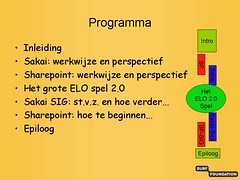
{Dutch} Next wednesday I will be facilitating a workshop (Het grote ELO spel 2.0) for quite a large audience (>75 people are expected). I am doing this together with the community manager for the Sharepoint SIG. We will be focusing on the trends in our society and the impact it has on education, and vice versa.
During the workshop we will be asking the audience to step into another perspective (e.g. adminstrative staff or CIO) and think about the innovative use of ICT from these perspective.
See the SURFfoundation website for more information (in Dutch).
Some questions answered
Updated on April 13. During Peter Bavinck's (Oracle, The Netherlands) talk on April 4, some interesting questions were asked. Peter has been so kind to gather the answers to the questions that were asked on content management, eportfolio and more. The answers will be sent directly by email by Peter to those that had questions.
donderdag, april 12, 2007
What do you think of Sakai conferences?
In case you missed it: there is an intensive and open discussion on when, where and how often Sakai conferences should take place. This is what is so good about Sakai: the open, positive athomospere that shines through in every discussion like these.
woensdag, april 04, 2007
Our meeting was great fun!
Today I had a great day. This was due to the great weather (at least if you were behind windows), but even more to the great meeting we had today with the Sakai SIG NL.
The following institutions were present: University of Amsterdam, University of Twente, Free University, University of Utrecht, University of Applied Sciences of Utrecht, Mondriaan Onderwijsgroep, Saxion University, Hotelschool The Hague and the Leidse Onderwijsinstellingen. Quite an large list, or not?
But not only that, also present were quite a few commercial parties involved in Sakai (in no particular order): Edia, Stoas, Oracle, A New Spring, Portfolio4U and Omix.
I would dare to say that Sakai is quite known in The Netherlands. The next step is that we all start using Sakai!
The concise meeting notes are available at our website. Some photos at Flickr.
dinsdag, april 03, 2007
Sakai and the University of Twente
Just a short note here, especially for those attending our meeting tomorrow that want to know the details of our status. All links in this post will give you information in Dutch, so be warned.
We are approaching the end of our pilots with Sakai at our University. Actually we have started writing our final reports that should be finished by the end of May 2007. It is currently a bit unclear to me what the next steps will be with our reports. What is clear to me is that MS Sharepoint right now is seen as a very serious alternative to Sakai at our University (which was not the case one year ago!).
{Dutch} Als je geïnteresseerd bent in de actuele stand van zaken, lees dan ons statusrapport op onze website.
maandag, april 02, 2007
Reflecting on Innovatium 2007
Last Tuesday the large Innovatium (photos) conference was held in Amsterdam. We were there with a booth (photo after the click). At first I was not so happy with our location. We were upstairs, where none of the action (workshops and presentations) was taking place. But during the lunchbreak people started moving by. Together with Stanley Portier (read his impressions), Frank Benneker and Martine Hilderink we had lots of interesting discussions with the passers-by. We handed out our official flyer, as well as other interesting articles (Morgaine and Wheeler, as mentioned earlier).
There were two conversations that I would like to make note of here. I had a rather interesting conversation with a teacher that was involved in educational projects for and in third world countries (in Africa). His questions were about using Sakai on outdated PC's (should work!) and regarding the bandwidth needed for Sakai on the end-user side (is not so high, not much graphics), as well as the horsepower needed for a server to install and deply Sakai properly (should be OK, you can do it all with opensource software for the whole stack). He already knew quite well that Sakai (but also Moodle) are opensource and therefore free to deploy, which was good to hear! This reminded me of the ITC institution here in Enschede, that has told us that they have some problems with using Blackboard with their partner institutions in the Far East (this kind of use is apparantly not allowed according to the licensing terms).
The other conversation that I found interesting was more a philosophical one: what do we, as an educational institution, really need to offer (with regard to ICT applications) to our students in this Web 2.0 world? Can we not make a proper VLE just by referring the students to stuff like Google (e.g. Gmail, Docs and Groups) and all the free content that is out there. The problem here is, in my opinion, that Google (or other Web 2.0 stuff) is not free in the same way that Sakai is free. There are a lot of restrictions that apply when using Flickr, for example.
vrijdag, maart 30, 2007
Do you kow this weblog?
{This is a little plug for a great weblog} The UBC Arts ISIT Blog is a community blog from the Instructional Development unit at the Faculty of Arts, at the University of British Columbia.
There are some interesting comparisons on Sakai and WebCT on the weblog, as well as some comments and thoughts on Sakai from the standpoint of a teacher. Just go to the weblog to see for yourself. I am curious who the actual writers are on this weblog. Anyone have an idea?
There are some interesting comparisons on Sakai and WebCT on the weblog, as well as some comments and thoughts on Sakai from the standpoint of a teacher. Just go to the weblog to see for yourself. I am curious who the actual writers are on this weblog. Anyone have an idea?
Next meeting: April 4
As you know the conference committee is doing a great job in selecting and reviewing the proposals for the Amsterdam conference. The 'results' will be available shortly.
In the meantime I have everything set up for our 5th meeting of the Sakai SIG NL. It will be held in Utrecht, as usual, at the SURF offices. A detailed agenda (in Dutch) is available. If you haven't received an email regarding this meeting, but are planning to attend, please let me know (so that I can count you in for the lunch!).
In the meantime I have everything set up for our 5th meeting of the Sakai SIG NL. It will be held in Utrecht, as usual, at the SURF offices. A detailed agenda (in Dutch) is available. If you haven't received an email regarding this meeting, but are planning to attend, please let me know (so that I can count you in for the lunch!).
donderdag, maart 29, 2007
Vote for Sakai!!
Please put your vote for Sakai on the Unesco website.
As you can see, Sakai is not on the top of the list, instead of that the product Olat from Switserland is number one. They placed a voting link on there website, very clever.
Indeed….also Unesco is looking seriously into Open Source Sofware.
If you want to check out more about this, visit the Unesco website about Freesoftware by clicking on the following link: http://www.unesco.org/ etc...
woensdag, maart 28, 2007
The audience
Yesterday the Innovatium conference was held in Amsterdam. As said earlier here, the attendance was quite large. I received quite a few people at our Sakai booth. I will tell some more later on in this week. The printouts of articles by Wende Morgaine and Brad Wheeler were quite handy to give out the interested visitors of our booth, as well as some reports that I wrote earlier.
Another interesting report that I handed out was the Open Source Catalogue 2007 (registration required), by Optaros.

Another interesting report that I handed out was the Open Source Catalogue 2007 (registration required), by Optaros.
vrijdag, maart 23, 2007
Sakai SIG NL op Innovatium 2007
This is the first slide of the self-running presentation that we will be doing at the Innovatium conference, next Tuesday (27 March). See www.innovatium.nl for all the details (in Dutch). Expected audience is 500+, and they are all more or less interested in ICT, in education, in elearning etc.
We will not do a regular presentation, but instead we have a booth where we will be presenting Sakai and our Special Interest Group. We will also promote the upcoming Amsterdam Conference ofcourse.

We will not do a regular presentation, but instead we have a booth where we will be presenting Sakai and our Special Interest Group. We will also promote the upcoming Amsterdam Conference ofcourse.
Wende Morgaine speaks about Sakai in Campus Technology Magazine
More than Open Source: a second look at Sakai.
The words of Wende Morgaine (faculty member at Portland State University), published in the online Campus Technology Magazine.
Check out the full article:
http://campustechnology.com/articles/45387/
Have a nice weekend, cu you all 4 april at the Surf office, Utrecht.
The words of Wende Morgaine (faculty member at Portland State University), published in the online Campus Technology Magazine.
Check out the full article:
http://campustechnology.com/articles/45387/
Have a nice weekend, cu you all 4 april at the Surf office, Utrecht.
donderdag, maart 22, 2007
Another new 'member'
Last week I informed you that Oracle will be present at our upcoming meeting of the Sakai SIG NL on April 4. Peter Bavinck will present to us the latest information on the Oracle's Academic Enterprise Initiative.
This time I would like to inform you that we will have another new party at the table: 2useit.nl, that has been contracted by Hogeschool Utrecht. They will also share some more information on their assignment for Hogeschool Utrecht, which is one of the largest University of Applied Sciences in The Netherlands.
This time I would like to inform you that we will have another new party at the table: 2useit.nl, that has been contracted by Hogeschool Utrecht. They will also share some more information on their assignment for Hogeschool Utrecht, which is one of the largest University of Applied Sciences in The Netherlands.
dinsdag, maart 20, 2007
Is this a coincidence?
As I was surfing away on the internet recently, I found that the Holland Open conference will be held on June 11 and 12. This is in the same week as the upcoming Sakai conference. I've contacted the organization committee of the Holland Open conference, to discuss where we can help and enhance each other's efforts and attendance. I will keep you posted!
donderdag, maart 15, 2007
My apologies
My apologies for all those reading this trough Planet Sakai or a feedreader. Apparantly if you edit older posts (which I did: I added some labels to some posts this morning) in Blogger, they will be featured as 'new' posts in the feed (not on the weblog itself). My 'real' most recent post was about the upcoming Sakai 2.4 release, as you can see when you visit the webpage of this blog.
Recently I read somewhere that you can avoid this typical behaviour of Blogger by adding some parameter to the feed URL, but unfortunately I cannot find this piece of information anymore.... Doe someone have any clues?
Recently I read somewhere that you can avoid this typical behaviour of Blogger by adding some parameter to the feed URL, but unfortunately I cannot find this piece of information anymore.... Doe someone have any clues?
Sakai 2.4 is on it's way
Besides all the activities in organizing and preparing yourself for the upcoming Sakai conference in Amsteram (today is the last day to send in a proposals; ours have been sent in!), the 'normal' work also progresses within our community.
Yesterday the first release meeting for Sakai 2.4 was organized by Megan May. This is what she sent out: "(..) all teams have until 12:01am Eastern on March 19th to check in changes. Due to the change in date for the code freeze, the official release date for 2.4 will now be Friday, May 4. " All details on the QA cycles on this release can be found on a seperate space on the community wiki (Confluence).
The latest official release (we missed this on this weblog) was on February 12. At that date Sakai 2.3.1 was released, which was a security release. At the University of Twente we succesfully deployed this release on March 8 for our pilots. See more detailed info, also on the community wiki.
woensdag, maart 14, 2007
Is Dell really listening to Ideastorm?
Ideastorm is a website, courtesy of Dell, that asks us for some suggestions and ideas that could make Dell an even better company, with better products. The idea is very simple: just ask your (potential) customer what they want!
Not surprisingly (*at least to me*) is the fact that the number one suggestion on the list is "provide us with PC's that have a Linux distro installed".
There is also an online questionnaire that you can fill in, to provide Dell with some more details on our wishes. I strongly suggest you to do so!
Researching a little further I came across the weblog of Mark Shuttleworth ("the father of Ubuntu"). He also comments on Ideastorm. And then it gets funny... he refers to the bugtracker system for Ubuntu. Their #1 bug has the following title "Microsoft has a majority market share" (and has as nickname "liberation")! The bug is still not resolved..... But I think we are getting there.
Just a thought: would Shuttleworth be a keynote speaker we would like to have in Amsterdam? Just chime in.
maandag, maart 12, 2007
Portfolio4u joins Sakai commercial Affiliate program
Portfolio4u -- Sakai Hosting, Training and Implementation Services for Schools and Organizations in the Netherlands
Portfolio4u delivers for-fee Sakai implementation and hosting services to schools in the Netherlands. There are more now more than 40 schools and organizations assisted by Portfolio4u in their experiences and experiments with Sakai! Portfolio4u provides consulting, training, customization and Sakai hosting in a professional data center in Amsterdam. These services allow schools to get started using Sakai quickly and professionally. Portfolio4u maintains partnerships with fellow Commercial Affiliates IBM Corp. and Sun Microsystems and has been dedicated to educational portfolio software since 2001.
"We see the opportunity to formally join the community as a way to financially support the efforts of the Foundation and to enhance our cooperation. We look forward to working more closely with the community as a Commercial Affiliate and seeing many members of the community in June in our home city, Amsterdam."
Jim Doherty,
Director Portfolio4u b.v.
jim@portfolio4u.nl
www.portfolio4u.nl (website is in Dutch Language)
vrijdag, maart 09, 2007
Oracle joins Sakai SIG NL!
The last couple of weeks were full of exciting experiences and thoughts; I won't share them all with you (just check my photostream for a little more).
The most important newsitem was the fact that representatives from Oracle here in The Netherlands have informed me that they want to join forces with our Sakai SIG NL. I think this is great news for all of us in The Netherlands.
Ofcourse Oracle is a commercial affiliate since a couple of months. They are working hard on their efforts that can benefit all of us that have a special place in their heart for Sakai. Next week there is a BIG Oracle conference in Orlando, where Sakai and Oracle will be discussed also, I hear; anyone going?
Anyway: Oracle has confirmed to me that they will be present at our next meeting, which will be held on April 4. And they not only will be present, but they also will share some our their thoughts and ideas with us. So, if you want to hear this first-hand, please be present in Utrecht next month.
maandag, maart 05, 2007
Some results of OSP trials
I read Seb Schmoller's (from the UK) weblog regularly. Recently he posted some results and viewpoints from trials that have been done with Open Source Portfolio in Southern England. The post itself is well worth a read for all those involved in eportfolio's, OSP and Sakai. See Whose world is it? OSP/Sakai, Moodle and Web2.0 in Further and Community education.
vrijdag, maart 02, 2007
Our proposals for sakaiamsterdam07!
Although it might seem that the Sakai conference in Amsterdam is far away (it is in June!), preparations for the conference are well underway. Actually the first deadline is approaching fast, which is the deadline for sending in proposals (link to the online form). The deadline I am referring to is set on March 15, 2007 (so that is only 13 days away).
We will send in at least two proposals.
The first one will be focused on our experiences so far with Sakai. This will be a sort of 'off-site site visit'. This will be geared at those of our collegues that have contacted us for through email requesting a site visit to Twente. We think this would be too time-consuming (on our side organizing it, but also for the people that have to travel to our university which is about 160 kilometers - or 100 miles- east of Amsterdam).
Our second proposal will be more of an overview presentation of what the Sakai SIG NL has been doing since the official start in August 2006. I will look back in time, but will also try to look into the future a bit in this presentation.
In sincereley hope that there will be whole bunch of Dutch presentations and poster in Amsterdam. The record so far for the number of Dutch presenters at a Sakai (to the best of my knowledge) has never been more than 5. Let's aim at 6 for Amsterdam!
BTW: shall we all use the tag (or label) "sakaiamsterdam07" for all our tidbits on the upcoming conference? the URL http://www.sakaiproject.org/sakaiamsterdam07 is even working now!
vrijdag, februari 23, 2007
Sakai lunch revisited: your help is appreciated!
In our Sakai pilotproject at our university (University of Twente) we are striving to be as transparant, open and communicative as possible. We are trying very hard to let the end-users be part of our evaluation process. Therefore we organized our first Sakai lunch last January. This was quite success, as I mentioned earlier on this weblog. Therefore we will organize a second lunchmeeting (announcement in Dutch) on March 13 at our university, for all those people that could not attend.
The format we used for the meeting was quite interactive. Ofcourse we started with some information that we wanted to share. But then we turned 180 degrees: we asked the participants to write down their questions, but also their tips. And we turned those questions (with our corresponding answers) into seperate page on our wiki. Check it out (page is in Dutch).
There were lots of questions and some very interesting tips. I'd like to highlight a few here:
1/ Visual appearance of Sakai (or the UI). This was identified as a factor that should be improved within Sakai.
2/ Make some effort in training the faculty in using Sakai. Actually this might a broader issue: the use of our current VLE (TeleTOP) is quite diverse. Students would like to have some sort of baseline use of the VLE. E.g. that in every coursesite the Schedule is filled in a consistent way etc.
3/ How do we go about in the transition period, when the old VLE and Sakai both are available? What are best practices?
And, for this last question I would like to invite the community to respond. Any thoughts?
maandag, februari 19, 2007
Starting up
I am just starting up my work stuff, as I returned from a vacation in Sri Lanka.
Three things to get this weblog started again:
1/ The meeting notes of our 31 Jan meeting are already available. We had a great attendance and some interesting news that was shared. Not everything is in the meeting notes... so, please be present next time (which is on Apr 4, in Utrecht, as always).
2/ The Sakai Foundation seeks to recruit a UX (User eXperience) Lead, which is great news! Everything can contribute money to make this happen.
3/ On March 27, the Innovatium conference will take place in Amsterdam. We will be present.
dinsdag, januari 30, 2007
Some suggestions for our Sakai project
Today we had a successful lunch meeting with faculty and students regarding our Sakai project. We presented very briefly what we have done so far and what our next steps will be.
We asked for some suggestions and for next steps from the audience. We received quite a few. Some are pictured here. We also asked for questions people still would have.
We will try to provide answers to the questions by means of our wiki.
See the rest of the photos (and the suggestions) at Flickr.

We asked for some suggestions and for next steps from the audience. We received quite a few. Some are pictured here. We also asked for questions people still would have.
We will try to provide answers to the questions by means of our wiki.
See the rest of the photos (and the suggestions) at Flickr.
maandag, januari 29, 2007
How opensource works (NOT!)
Through the weblog of Alfred Essa, i got directed to a blogpost by Joel Spolsky. Joel posted his personal review of a great book (Dreaming in Code by Scott Rosenberg). The book deals with the Chandler project. The Chandler project had been 'advertized' as the Microsoft Exchange killer app. But it didn't even get close up 'till now.
As Joel puts it: "Chandler’s original vision was pretty much just to be “revolutionary.” Well, I don’t know about you, but I can’t code “revolutionary.” I need more details to write code. Whenever the spec describes the product in terms of adjectives (“it will be extremely cool”) rather than specifics (“it will have brushed-aluminum title bars and all the icons will be reflected a little bit, as if placed on a grand piano”) you know you’re in trouble."
Joel really makes the point that software needs to be designed properly, before it should be developed! I couldn't agree more.
I can see some parallels here with the Sakai community. How many designers do we have? The Course Management Working Group does an excellent job at documenting their design process and choices they make, I think. And there will be a lot more than that, ofcourse. But, in other areas within the Sakai community I have a hard time to figure out where the design is to be found.
So, this puts me right on the ground again about what the Sakai community still has to cover. But we will get there! Watch us.
vrijdag, januari 26, 2007
Blackboard patent will be re-examined
Source: Software Freedom Law Center
"In response to a formal request filed by the Software Freedom Law Center (SFLC), the United States Patent and Trademark Office (USPTO) today ordered re-examination of the e-learning patent owned by Blackboard Inc.(..) A re-examination of this type usually takes one or two years to complete. Roughly 70% of re-examinations are successful in having a patent narrowed or completely revoked."
"In response to a formal request filed by the Software Freedom Law Center (SFLC), the United States Patent and Trademark Office (USPTO) today ordered re-examination of the e-learning patent owned by Blackboard Inc.(..) A re-examination of this type usually takes one or two years to complete. Roughly 70% of re-examinations are successful in having a patent narrowed or completely revoked."
dinsdag, januari 23, 2007
Agenda for Jan 31, 2007
For all those that speak Dutch, please read our agenda for our next meeting. The meeting will take place in Utrecht, at the SURF offices.
I am expecting around 20 people (that is at least what SURF is catering for regarding lunch). I you are planning on attending our meeting, please let me know *by sending an email to me or * by placing a comment on this post.
I am expecting around 20 people (that is at least what SURF is catering for regarding lunch). I you are planning on attending our meeting, please let me know *by sending an email to me or * by placing a comment on this post.
maandag, januari 22, 2007
Bootcamp in Amsterdam!
This is your chance! If you always wanted to know what developing and programming for Sakai is like, you should take note of the Bootcamp page on our wiki. This is the page where you will find all the information on this great workshop for programmers. The Bootcamp will take place during our upcoming Amsterdam conference. So, mark you agenda for June 12-14!
The 'faculty' are already preparing this bootcamp. This will be the first time that the Bootcamp will take place in continental (thanks for the hint, Anthony!) Europe. Previous editions during the Vancouver and Atlanta conferences, as well as in Oxford (UK) last September, were a huge success.
Update: Anthony Whyte reminded me that there was a Bootcamp in Oxford recently.
vrijdag, januari 19, 2007
Free publicity
After my talk at the OSOSS conference, i was asked if I could make a 'transcript' of my presentation that could be made widely available. Well, actually I was asked to write an article about Sakai, based on my presentation, that could be published online at www.livre.nl. Livre has a comprehensive website where a lot of 'open' news is published.
Livre is a free and open network organisation within The Netherlands that is dedicated to the use of open source and open standards to facilitate ICT innovation. In Dutch: "Het creëren van bewustwording over ICT innovatie die is gebaseerd op de waarden open, vrij en duurzaam."
See what I have written (in Dutch). The article gives the Dutch reader a comprehensive and current overview on Sakai, as well as some insight in the Dutch adoption (rate) of Sakai.
woensdag, januari 17, 2007
User Interaction, work in progress
In a post on this weblog Wyzte Koopal pointed out that the User Interface & experience is an important issue to address. I think Wyzte will to glad to read that User Interaction Group is working hard to collect to use cases and to discuss them with the community. People who want to read more about the ongoing User Interface work should read the UI pages on the Sakai Wiki, http://bugs.sakaiproject.org/confluence/display/UI/Home
During the Amsterdam Conference a full day pre-conference workshop will bring together all the members that have a sincere interest in improving the Sakai User Experience.
The U-Camp will provide an opportunity for those interested in the design and support of Sakai to meet, learn, and contribute to the future of the Sakai user experience.
This pre-conference session will include a series of workshops and presentations in the morning where participants will discuss design methodologies, accessibility, patterns, and usability. In the afternoon, we will focus on strategies for improving user delight within Sakai and finding ways to better represent user needs within the community process. (Authored by Colin Clark)
More information: http://bugs.sakaiproject.org/confluence/display/UI/U-Camp+Planning
Planning of the Sakai Amsterdam conference is on it’s way
Last week Susan Hardin and Mary Miles ( Sakai conference committee) visited Amsterdam to have a look at the conference hotel and to feel the city. In spite of the rain and wind they got a good view on the conference hotel and other options in the city. The pre-conference day will be held at the University and the main conference will be held at the Mövenpick.
In February more information on the Amsterdam conference will be posted on the Sakaiproject website.
Frank Benneker and Mary Veugelers (University of Amsterdam) will work closely with the Sakai Board and Community to make the meeting a huge success.
More information on the conference hotel: Mövenpick Amsterdam
maandag, januari 15, 2007
Everyone can join, as long as...
This is just a quick reminder. We will be having our 4nd meeting with the Dutch Sakai community on Jan 31, at the SURF offices in Utrecht. Official starting time is 10.30 hrs. Everyone is welcome at this meeting (a short confirmation by email is appreciated), as long as you are able to understand (and/or speak) Dutch. The official language of the meetings will be Dutch, since we are the Dutch community.
Our meeting room will hold approximately 25 people. I will be finalizing the agenda for our meeting on Jan 24 (next week). I have one confirmed presentation, which will be an interesting presentation by Walter Brand (Memotrainer BV), who will tell us more about what they did for Elsevier Opleidingen.
Our meeting room will hold approximately 25 people. I will be finalizing the agenda for our meeting on Jan 24 (next week). I have one confirmed presentation, which will be an interesting presentation by Walter Brand (Memotrainer BV), who will tell us more about what they did for Elsevier Opleidingen.
donderdag, januari 11, 2007
High level exposure for Sakai
This post deals with some specifics of the way we work together within The Netherlands regarding the use of ICT in Higher Education (HE). This might be interesting for foreign readers, but it might be more interesting for my Dutch readers, I guess.
Yesterday I was invited to do a short presentation for SURF. What is SURF, you might ask? Here are some quotes from their website, that say it better than I could: "SURF is the collaborative organisation of and for the institutes for higher education in the Netherlands. (..) The statutory organs of the SURF Foundation are the General Board, the Executive Board and the Scientific Technical Council. The administrative representation is implemented within the three SURF platforms: Research, Education and Organisation."
So, SURF is in fact the (only!) national organisation where every and all HE institutions work together on the improvement of the use of ICT within our institutions. SURF is also facilitating this weblog, some of my time that I am spending on Sakai, and the meetings that we regularly have in The Netherlands with all those that are interested in Sakai.
I was invited for the quarterly meeting of the Board of the ICT and Organisation Platform on January 10, 2007. Members of this board are executives from 8 different HE institutions within The Netherlands.
I presented (presentation in Dutch), within a short timeframe, what Sakai is, who is involved within The Netherlands, what our vision is etc. I think I did a good job of informing the Board and thereby gave some more exposure for Sakai on the executive level within HE in The Netherlands. Questions that got asked where mainly on the level of "does the community really work?" or "who is actually using Sakai right now?". More specifically some of the board members were quite interested in the fact that OSP is used quite widely already within secondary vocational education in our country. The board was very pleased with the presentation and wished us luck for the future.
Oh, and there is one more thing that came up during our short discussion: Sharepoint. This is our main "competitor" within the Netherlands. And Sharepoint has a distinct advantage, that was laid out nicely in the discussion: the user interface is so familiar....people are so used to all this stuff from Microsoft. So, once again, at least for me, one more reason why the Sakai User Experience should be high(er?) on our agenda.
What do you think?
maandag, januari 08, 2007
Sakai and Oracle: more news
On the weblog of Michael Feldstein, who recently started working for Oracle, you will find some more information on the way Oracle is seeing Sakai.
There are two initiatives that Oracle is working on with regard to Sakai. There is the Academic Enterprise Initiative (AEI) and there is Sakai for Oracle. A tiny quote: " “Sakai for Oracle” is not intended to be a fork; it is intended to be a supported configuration."
Please read the complete post to get to grips to what Oracle is doing for the Sakai community.
vrijdag, januari 05, 2007
Sakai SIG NL Feed Subscribers
Since the start of this weblog, we've been using Feedburner to keep track of the usage and the users. The usage of the feed of our weblog is at 22 subscribers as of today. We are steadily on the rise here (we had 10 subscribers as of October 31, 2006).
What surprises me most (in the happy sense of the word) is that the preference for Netvibes is so huge. Personally I like Netvibes very much, and I use it regularly. Is Netvibes some sort of preference within the (would-be) Sakai community? Anyone wants to comment?

What surprises me most (in the happy sense of the word) is that the preference for Netvibes is so huge. Personally I like Netvibes very much, and I use it regularly. Is Netvibes some sort of preference within the (would-be) Sakai community? Anyone wants to comment?
woensdag, januari 03, 2007
Weblog has been migrated!
A couple of weeks ago I emailed all of the authors of this weblog that we would be migrating this weblog to the new Blogger during the Christmas break. Actually we migrated today. And we are up and running again.
For those who would like to be (or stay) author for this group weblog, there is one caveat: you need a Google account. If you have an Gmail emailbox, you are by default the owner of a Google account.
More info on migrating and switching can be found in What is new and improved? or Switching teamblogs.
donderdag, december 21, 2006
New kid on the Blog
I am new on this Sakai NL blog. My name is Jan van den Berge and I am one of two founders of Portfolio4u. Portfolio4u has translated Sakai to the Dutch Lanquage in cooperation with the UvA (University of Amsterdam).
We are specializing in the Digital Portfolio part of Sakai by using the OSP inside Sakai. Our main customers are educational institutes in the Netherlands starting with student from the age of 12 to adults. At this moment we have more than 16 Sakai implementations and more are on there way.
I visited the last Sakai conference a few weeks ago in Atlanta and I was surprised by all the work that already has been done all around the world.
For me as a sales person of our company I found it hard to believe we can make business with free software. But now, after 1,5 years working with Sakai and the community, I am convinced about the power of Open Source Software and how to make a business of it.
We have contributed our translation to the community and got a lot of things in return from other members of the community, so...it works. It's a new way of thinking, new ways of telling our customers about Open Source Software and news ways of developing the tools and setting up our infrastructure. It's a great feeling to know people all around the world that are doing the same thing.
What I learned in Atlanta is how things are changing at the moment. Big players like BlackBoard seem to going out of business or have to change doing business in a complete other business model. I don't know if they are capable in doing that, so.. time will learn.
Ofcourse not everything is sunshine and lots of work has to be done, but what matters to our company, we believe in it. By specialising in the Portfolio part of Sakai we are one of the few people that are doing that in the world.
We believe that it is a good idea for a school to start working with portfolio's and after that slowly let the application grow to a bigger thing thats supports the complete educational process.
Working with e-portfolio's needs a real serious implementation. You need to look very carefully to the needs of the school and most importantly, what are the skills of the teachers and students. Students are mostly not the problem, but we learned in the last years that lots of teachers have problems or even fear working with digital tools and let go some of their power on groups of students.
So it is not a matter that teacher's dont want to change but lots of them are afraid of losing something. Something that they cannot explain, but it is the way the are working now for centuries. I don't think this New learning is a small change. This is something bigger, it seems to be like a learning or knowledge revolution like many years ago happened during the industrial revolution. So this will be not a easy process but finally people will be learning in an other way then they are used to now.
I believe the future of teachers will be much more interesting then it is now. They are changing from the teacher to coach. Someone thats helps the student how to learn instead of telling him/here exactly what to learn. This wil take still lots of years but you can see the change and the growing believe in this New way of learning.
Tools like Sakai will help teachers in learning to work in new ways. So it's not only a matter of developing this great tool but it is also a matter of learning how we can learn our teachers in using this new tools and finding new way's of working with students.
It seems that the use of the e-portfolio part in Sakai is very strong in the Netherlands and maybe we can tell the community more about what the developments are in The Netherlands during the next Sakai conference in June 2007, Amsterdam.
For the near future we have to develop more and new tools for connecting Sakai to other applications like administration tools and goal registration applications. That shall be a lot of work but I think we can do lots of devellpment within the community.
For now this is my first contribution to this blog and I hope you liked it. I am looking forward of meeting you at the next meeting in januari 2007. I wish you all a great Christmas time and lets make 2007 a real Sakai year.
woensdag, december 20, 2006
Just in case
In case you have not been able to find our 'official' website, I would like to remind you that we have one! It is located on http://elearning.surf.nl/sakai_en (this is the English version; but there is also a Dutch version, at http://elearning.surf.nl/sakai_nl).
On our website you will find our meeting minutes of face-to-face meetings that we have on a regular basis. Our last meeting was on November 22 (minutes of this meeting; in English). Our next meeting will be on January 31, 2007. The website is equipped with an RSS feed too!
On our website you will find our meeting minutes of face-to-face meetings that we have on a regular basis. Our last meeting was on November 22 (minutes of this meeting; in English). Our next meeting will be on January 31, 2007. The website is equipped with an RSS feed too!
donderdag, december 14, 2006
My audience in Arnhem
Today, as I mentioned already, I presented at the yearly Open Source symposium. This symposium is mainly geared at the local governments, of which there are more than 400 in The Netherlands. The aim is that they will start working together more closely on the exchange of knowledge on open source and also open standards. Most prominent use of open source in this area is OpenOffice and Linux, but also in the GIS application area.
My first question to the audience was who knew what a VLE (or CMS) is. Most hands were raised, which was actually quite surprising to me.
My talk went OK. I think I have shown that, besides the already mentioned Linux and OpenOffice, there are other areas where opensource software is quite succesfull. It might well be that, because local governments are quite receptive to opensource, that some of them will start trying out Sakai.
Actually most local governments are funding directly lots of primary and secondary schools. We will see who sends me an email in the coming days.
woensdag, december 13, 2006
Tomorrow: Arnhem
Tomorrow I will be doing some evangelism (can I say that?) for Sakai. I will be presenting Sakai (the product, the community, our university and Sakai) at a conference (only in Dutch) primarily focused on the use of open source in local government(s). There are talks about GIS, content managements and OpenOffice.
Maybe I can get some attention and can attain some valuable contacts within this area of our society. You never know. I will keep you posted!
Maybe I can get some attention and can attain some valuable contacts within this area of our society. You never know. I will keep you posted!
zondag, december 10, 2006
Brooklyn Bridge

Because of missing our connecting flight from JFK to Amsterdam, Allard and myself had to stay in New York for one day. We spent this day like real tourists: taking lots of pictures, riding the subway, visiting Brooklyn Bridge, Ground Zero etc. Finally we are home today (Sunday), tired as hell. Our suitcases are still somewhere between New York and Amsterdam :-(
Next time, one thing is sure: we will take a direct flight!
zaterdag, december 09, 2006
Moving to Stoas
This is sort of a personal announcement. I'll be working for Stoas in the new year. I was at the Atlanta Sakai Conference over the last couple of days and realized, when talking to people, that it would be a good idea to give it a little more public attention.
I have had wonderfull years at the University of Amsterdam and learned a lot. In my new position at Stoas I'll be able to work on exisiting systems like Blackboard and new systems like Sakai and other interesting initiatives.
Please feel free to contact me at 'vma {at} stoas {dot} nl'.
Victor Maijer
vrijdag, december 08, 2006
Mixed Sakai feelings
Although my review of the SAKAI system was rather critical I’m impressed by the devotion of the people at the conference. It is nice to see that so many people are working on a development of a system and also come to this kind of conferences. And then of course, this is only the tip of the iceberg, it is a large motivated community. But… I’m still wondering (and I think most of the people here) were we are going. Sometimes the presentations preach of a better open new collaborative world, were everything should be free and we all work together. I also heard a lot of people like myself that have problems with using the interface of the system, and that these problems are not taken seriously by the SAKAI board. So may be we all work together on the same system, the goals, expectations, and requirements do vary for each partner, and almost each individual. The fact is that developments focus on integration, in my opinion it is all very interesting to see that such big interest exists for such kind of tools, but that the investments are enormous and the question is how long these investments and interest will continue. The popularity of Moodle shows also that a large group is still interested in a easy to use, free e-learning system that can be used in a simple way… But for Sakai still a lot has to be done :-)
Do you like German beer?
"Das tolle bei Sakai ist ja immer, das hier viele kleine Tools benutzt werden und die Community wirklich funktioniert." This is the beginning of the latest post on a German weblog that has existed now for some months, where Andreas Wittke is the leading figure. I am going to do a little promotion here for this weblog... So, if you are interested in news about Sakai in the German language, then go the weblog of our collegues from Lübeck.
donderdag, december 07, 2006
On usability evalation of Sakai
Jonathan Howarth is graduate student and has done research on usability of the course management features of Sakai. At Virginia Tech they also use Blackboard, which is quite good in usability.
Jonathan gave an excellent presentation. He started with some fine examples of (un)usability. And then went along with a little theory (just right!): Usability is characteristic of an interactive system that indicates ease of use and usefullness. It is not 'user friendliness' only. The system should help you accomplish something.
Then Jonathan talked about the goals of the usability testing he carried out. The setup of the testing was that of a walkthrough. The 5 participants involved had to do 17 tasks within Sakai 2.2 (they call it Scholar) and had to articulate what they were doing.
The positive feedback that came back from the users: variety of tools is great, thorough Help system, mechanisms for supporting collaboration (although the test was on the course management features of Sakai).
There was a series of usability problems, that some of us are all too familiar with. One of my collegues, Allard Strijker, came to same sort of conclusions after using Sakai 2.2 in his course. The biggest issues that Jonathan has found: terminology, consistency, sections and groups. In the presentation the problems were shown with video's that were recorded. These video's were very informative (you could see the screen and hear the user talking). Some examples: (terminology) The use of the word Roster is different in the Site Info and Gradebook, (consistency) Removing students or removing sections works completely different.
There were much more video-examples in the presentation. They are not on Confluence, because of privacy regulations. You missed something very illustrative, if you weren't there.
User Experience: the theme so far
I am just sitting in on the presentation of the featured speaker of today, Briant Cantwell Smith. He is talking quite philosophical, so far. It should get interesting, I hear from someone who has listened to Brian before. And after some more minutes, it becomes indeed interesting. Briant asserts that people are very capable of swichting their attention (they go up and down the 'attention stack'). After this we heard some interesting implications for software, and specifically Sakai.
Think about this one: "Systems themselves should not occupy our attention - except in times of failure." Most of the times this is not the case in our current systems. One other implication: "Interface should not (in the first instance) provide transparant access to the system". Another implication is that we should pay attention to holism, the overall structure. This is available by thumbing through a book, but not really in software most of the times.
Brian concluded with a conclusion for Sakai: "the experience of the Sakai user should be a) building a research station in Antarctica, or b) participating in philosophy master classes". To put it another way around: the Sakai experience should be anything from a learning system.
Earlier this morning the partner representatives came together and had their 'private' discussion with the Board in the so-called Sakai Foundation Retreat. I won't dwell too much because of the 'privateness' of the discussion. I will leave it that we discussed different subjects. One of them certainly was the room for improvement for the user interface (or the user experience). We also talked about improving our internal communications and external communications. You will see the actions coming sometime near you.
woensdag, december 06, 2006
Realtime collaboration in Sakai: it gets better
Today,Miguel Gonzalez Losa from Lancaster University presented a new set of collaboration tools that they have developed to enhance the collaboration experience within Sakai. They have been funded by JISC in the area of e-Science (or e-Research).
The aim of the project was to create software that was useful, simple and extendable. They didn't want to create 'the most powerful' or 'the most complete' solution.
Features available in Agora are audio/video conferencing, whiteboard, shared desktop and chat. With a very simple PC, of a few years old, you can still have a conference room with 4 to 6 participants. They found a very simple solution for the desktop sharing application: they are only transmitting an image of the screen from person 1 to the rest of the persons. This seems to be enough for most use cases. The same goes for the chat tool: it is geared of sharing simple information like URL's of email-adresses. Everything that is done in the conference room is recorded for later viewing, which is strong feature! This recording is done a the client PC, so that you can (re)view it offline.
Agora can be used with no problem on Windows and Linux computers. For Apple the problem lies in the video and audio conferencing, which is a pity. There is a Agora server needed to make use of Agora.
There are lots of thing still to be done, as Miguel pointed out at the end of his presentation, e.g. whispering mode, full Mac support, encryption and SIP compliancy. They also want to make it available for more opensource projects, like Moodle. That would be a good approach for sustainability of this nice toolset.
Oracle and Sakai: next steps
Linda Feng had an interesting presentation on what Oracle is contributing to the Sakai community. The efforts of Oracle are in the area of exchanging information between Enterprise Campus Solutions and Sakai for course,
person, and enrollment information.
It got interesting when Linda started to talk about standards. So far IMS Enterprise Services v1.0 was not really a standard, as was concluded by their market investigation (every vendor had their own somewhat different implementation) that they have done. Linda and a collegue from Desire2Learn are heading the effort to create the IMS Enterprise Services v.2.0. The scope of this specification was decided on in Heerlen.
Also interesting to see was that they did some mapping between objects between Campus Solution and Sakai. This seems to work out fine, as far as I could see.
Some interesting questions by Linda, that Oracle wants answered by us, the users of Sakai and/or Campus Solutions:
Actually, in this arena there are (in general) 2 possibilities, according to another Dutch collegue in the session: you either go for the combination Blackboard/SAP or you go for Sakai/Oracle. All the rest (he means the local players in The Netherlands) is just 'spielerei'. What do you think?
person, and enrollment information.
It got interesting when Linda started to talk about standards. So far IMS Enterprise Services v1.0 was not really a standard, as was concluded by their market investigation (every vendor had their own somewhat different implementation) that they have done. Linda and a collegue from Desire2Learn are heading the effort to create the IMS Enterprise Services v.2.0. The scope of this specification was decided on in Heerlen.
Also interesting to see was that they did some mapping between objects between Campus Solution and Sakai. This seems to work out fine, as far as I could see.
Some interesting questions by Linda, that Oracle wants answered by us, the users of Sakai and/or Campus Solutions:
- Do we expect real-time interaction between Sakai and Campus Solutions?
- What will be the volume of transactions?
- How many enrollment transactions occur on average per hour? (during peak enrollment periods, during peak add/drop periods)
Actually, in this arena there are (in general) 2 possibilities, according to another Dutch collegue in the session: you either go for the combination Blackboard/SAP or you go for Sakai/Oracle. All the rest (he means the local players in The Netherlands) is just 'spielerei'. What do you think?
btw: this is post # 100 on this weblog! hurrah!
We have got a structure!
Charles Severance just started his overview of the Sakai Foundation. His main message was that we are not sprinting anymore, we are at a slower pace, but with much more quality and much more people involved. There were some other interesting messages from his talk:
- We now have a sort of organisation chart for the Sakai Foundation, which is good (this says that the Foundation is maturing). The Requirements process is one part of the Foundation, where users have their influence. Software coordination (including QA) and community communication are the other two parts of the Foundation organisation.
- Adoption of Sakai is still growing.
- There are some working principles, such as Public discourse as much as possible, meritocracy, distributed decision making. The essential principle is that there are no 'bosses' who make the decisions. There are project coordinators (and not managers!), which concept is stolen from the Apache Foundation.
- Because of the Requirements process (Mark Norton is coordinator), we don't have to burden the developers with these kind of stuff. They can develop!
- There is a community requirements summary for every release, so that there is a short document for everyone to read.
- Quality Assurance (coordinator is Megan May) is making more waves. QA makes the final call for a releases. QA broadens the community involvement, because not only nerdy people are involved here.
- Anthony Whyte is the coördinator for community communication.
- The only thing we are non-transparent about, is security. This is only communicated to people we know (which is also copied from the Apache Foundation) before we inform the public.
- Communication should be better :-). We are going to redesign the website and all that stuff that is behind it (seamlessly integrate confluence, jira and collab). One improvement that Chuck kept repeating: we need a document library. I cannot agree more.
- One important document in this document library should be a Roadmap.
dinsdag, december 05, 2006
U-Camp: a day well spent
Most of my day I was attending the U-Camp. The morning was spent with some pretty nifty presentations by different presenters. The presentations are(/will) be on the wiki page soon.
The afternoon was more interactive. We had some very interesting discussions on design and user interface issues regarding Sakai. Here are some current and future challenges for Sakai I would like to mention here, that came up during the afternoon.
The afternoon was more interactive. We had some very interesting discussions on design and user interface issues regarding Sakai. Here are some current and future challenges for Sakai I would like to mention here, that came up during the afternoon.
- We have, what was called the Microsoft Office effect: there is a proliferation of functionality within a tool (e.g. Resources tool) and therefore tool get less and less usable, certainly for the first-time user of a tool.
- There are tool-silo's. Newcomers are asking questions like "Why is it that I should put all stuff into the Resources tool?" Wouldn't it be great that we would have Flickr Uploadr tool (a litte desktop application), with the same user friendliness, to upload stuff into Sakai?
- Sakai technology is complex. Sometimes small changes seem to take forever. For example the Schedule: why is it so hard to display the title of the Month in the right place. Or another big user (support) issue: why are we still having the problem of the Back button, that doesn't behave as expected?
- Shouldn't user interface issues be part of QA?
- We should focus more on user scenario's (what does the user want to accomplish?) if we (re)build Tools
- Sakai as a product is mirroring the community, maybe... It is very difficult for different (working) groups to come to terms with other groups, and that is what you see reflected in the tool-silo's.
Evaluating Sakai after some months
Early this morning, just before the conference really started, I was interviewed by a Sakai board director. The board is in the process of talking with member institutions of the Sakai Foundation, to evaluate and steer the strategic directions of the Sakai Foundation for 2007 and beyond.
I really like the fact that the Board is doing this. The Foundation should know what the individual institutions are working on and where their issues lie. So that's what we talked about. We also talked a little bit about my role as the community manager for Sakai within The Netherlands.
My biggest issue with Sakai, for 2007 (and beyond) is what I would call 'marketing'. This is where our biggest challenge lies for the coming years. And marketing is not a BAD word for me. You might call it 'decent communication', if you like that better. Here are some examples of things I am thinking of.
I am thinking about the teacher, the director, the CIO or the educational designer that has heard of Sakai. I think we should provide them with some whitepapers (shall we call them "sakaipapers"?) that answers their specific questions. These sakaipapers should be easily available from our sakaiproject.org website.
I think we also need pertinent information regarding features of Sakai. And we really need information about features in future releases. I have not been able, so far, when asked questions, to direct an 'outsider' within The Netherlands to this kind of pertinent information to be found on the Sakai website. My belief is that this kind of information is what could convince someone of going to use Sakai. And if this information is not readily available, they will revert to whatever they are using right now. And ultimately that is NOT what we want, do we?
maandag, december 04, 2006
We are in Atlanta!
So, we are here in Atlanta. We, that is Allard Strijker and myself. We had some problems with synchronizing our train schedules, but finally we met at Schiphol airport right on time. After that we had a smooth flight to Atlanta. The biggest hassle (if you can put it that way) was the very strict security measures at the airport.
But once you are through that (no pictures!) security, you can hop right on the MARTA, which brings you almost straight to the conference hotel. Which is HUGE, btw!
Here you see Allard studying the map of MARTA.
Our collegues from Amsterdam should be here already. But haven't seen yet. I have seen Steve Githens already!
vrijdag, december 01, 2006
Critical Sakai review by Allard Strijker
My colleague Allard Strijker will give a presentation at the Atlanta Sakai Conference next week. Within a pilot of Sakai at the University of Twente in the study year 2006/2007 Allard used Sakai within an international master course on knowledge management systems. Together we collected the user experiences which are given from a teacher and student perspective. It's especially interesting to hear about Allard's experiences because he was closely involved with the design and development of TeleTOP, which is currently still the standard virtual learning environment for the University of Twente. Besides being a teacher at the Faculty of Behavioural Sciences, Allard may be considered an expert in the field of e-learning. At this moment I will not give away too much information about the presentation, you should hear it for yourself. But be sure there will be some critical remarks. However, I think we shouldn't react too defensive about that, referring to Chuck Severance's statement in Luebeck that the focus should now shift towards the user perspective. This is the only way we can learn from our users and it will help to improve Sakai into a better system. So for those who attend the Atlanta Conference: visit Allard's presentation in the Pedagogy track on Dec. 6th (10.30-11.30 INTL 1).
Busy schedule for Atlanta
Finally I had some time to take a look at the schedule of the Atlanta conference. The schedule is pretty dense and impressive. There really is a lot of good stuff! What strikes me (still!) is that almost all sessions in Atlanta are done by our fellow Americans.... I hope this has changed a bit when we are in Amsterdam. To have at least one genuine 'european' session in Amsterdam, we will have a Birds of the Feather (BOF) meeting for all fellow Europeans in Atlanta.
Besides this BOF, there are some other session that I most certainly will blog about on this weblog.
On Tuesday, Dec 5 (Sinterklaas!), I will be spending my day in the U-Camp: "(..) will provide an opportunity for those interested in the design and support of Sakai to meet, learn, and contribute to the future of the Sakai user experience." The University of Twente already did some preparation for this, which can be found here.
On Wednesday, Dec 6, the day will start of with a keynote by Eben Moglen. This talk will certainly deal with the Blackboard patent. Right after that (at 10.30 AM) my collegue Allard Strijker will present his first experiences with Sakai. At the same time, I might also go to a lecture on "Supporting a Sakai Roll-out". This might provide us with some valuable info on a possible roll-out at our campus some time next year.
At 11.20 AM on this same Wednesday, there is a session on the subject of bridging the gap between Sakai and a Student Information System. Sakai 2.3 has some new services and utilities to make bridging this gap easier. Later on that day (2.20 PM) there is another interesting session on this same theme. This session, from Oracle, is called Sakai Course Mgmt API and Oracle Enterprise Campus Solutions: Oracle will share strategy and architecture to support out-of-the-box integration between Enterprise Campus Solutions and Sakai for course, person, and enrollment information. We will also present analysis and prototyping results of course management integration based on the proposed Sakai Course Management API.
Patent should be reexamined!
Official press release on sakaiproject.org: "November 30, 2006 - The Software Freedom Law Center (SFLC) today announced that it has formally asked the Patent Office to reexamine and ultimately cancel all 44 claims of Blackboard's patent on e-learning systems (SFLC Press Release). The SFLC filed the request for reexamination on behalf of the Sakai Foundation (sakaiproject.org), the Moodle Community (moodle.org), and the ATutor Community (atutor.ca), three open source software projects which develop online educational systems."
There is also a Patent FAQ available.
There is also a Patent FAQ available.
woensdag, november 29, 2006
Sakai Webinars by Unicon
Yesterday I received an email from Unicon, Inc. inviting me to attend one of their upcoming webseminars on Sakai. I do not have the time right now, but maybe you have the time. Then please read on:
"Unicon offers Webinars for anyone who wishes to attend. However, seats are limited and an RSVP is required to reserve a seat.
Upcoming Webinars Provided by Unicon
Sakai Guided Tour Webinar. 11/30/06 (Tomorrow!)
Sakai Cooperative Support Webinar. 12/14/06
Sakai Guided Tour Webinar. 12/15/06"
So, if you are interested, please follow the link above to register.
Abonneren op:
Posts (Atom)

 Posts

