donderdag, mei 31, 2007

Meeting notes available (30 May 2007)

As usual, the meeting notes of our meeting are available on our website. Our last meeting was held on May 30, 2007 in Utrecht. Wytze and Frank provided some details on the way things work within the Sakai community. We had a seperate presentation by Portfolio4U.
Some photos are also available, ofcourse.

woensdag, mei 30, 2007

Come to the U-Camp!

Just a quick note: come and join the U-Camp! This is the email that Tim Archer from Australia sent out yesterday.
-----Original Message-----
From: Archer, Tim [mailto:TArcher@csu.edu.au]
Sent: Wed 30-5-2007 02:05
To: announcements@collab.sakaiproject.org
Subject: Amsterdam U-Camp
Hi All,
It would be great to see a wide range of people at the U-Camp at Amsterdam, both in terms of skills and geographic representation.
Currently, we have 22 people who have indicated that they are attending but only 6 from outside Northern America, and we would particularly like to see more Europeans, Dutch, South Africans, Australians etc :) so that we can enrich the whole experience!
If you are coming it would be a great help to add your name to the Attending U-Camp Roster page, at
http://confluence.sakaiproject.org/confluence/x/OXU
Tim (Chief U-Camp Herder)

zondag, mei 27, 2007

Question of the Week

Recently a new initiative was started by Peter Knoop (great idea!) within the Sakai community: you can vote on a question of the week through a poll.
The second poll is titled "Which three areas of Sakai do you think are the most important for your implementation?"
To respond, please access the Polls tool in the "DG: Open Forum" site on Collab. (Note: you need an account on Collab and have to be a member of this site to access the poll. If you need an account, go to Collab's home page and use the New Account tool to self-register for an account. If you are not a member of the site, then use the Membership tool in your MyWorkspace to join the site). Or click here and you will be (re)directed.
The question of the previous poll was: What version of Sakai do plan to be running in production in September 2007?
The results were
Sakai 2.1 (n=0) 0%
Sakai 2.2 (n=0) 0%
Sakai 2.3 (n=26) 24%
Sakai 2.4 (n=34) 76%

zaterdag, mei 26, 2007

Contrib(utions) from The Netherlands

While browsing through Confluence, I came across a (new!) Contrib bool from The Netherlands, Sakai Maps. I am not sure if this is really the first Contrib tool from The Netherlands, but is certainly worth a note here.
The SakaiMaps tool integrates Google Maps into Sakai and allows users to define and browse points of interest (POI) on the map. Each POI has a name, a short description, a type and optionally a url with more information.

donderdag, mei 24, 2007

Interesting presentations, part 1

As was promised earlier on this weblog we would like to highlight some interesting presentations that will be given during the upcoming Sakai conference in Amsterdam.
In this post two promising presentations that I would like to recommend:
1. An Open-Standards-Based Collaboration and Learning Environment. The Open-CLE project is a collaboration between Rice University and IBM. It aims to develop an open-standards-based, service oriented architecture to help educational institutions loosely tie together open source applications (such as Sakai, Connexions, and D-Space). Angela Rabuch and Mustansar Mehmood will be the presenters in this session. Go check it out on Wednesday, June 13, 14.05 hrs (in room Matterhorn 1). Some more info I found is at IBM and Rice.
2. Why German universities choose Moodle instead of Sakai is a presentation by Andreas Wittke and Rolf Granow from Germany. I myself can imagine some reasons why Moodle is chosen over Sakai. But this is still a presentation worth visiting, since this will also give some insight in how the Dutch Sakai community should be move forward. I will be there on Thursday, June 14, at 14.05 hrs (Zurich 2).

woensdag, mei 23, 2007

Agenda for next meeting (May 30)

Next week we will see the sixth meeting of the Sakai SIG NL. As always, we will be meeting at the offices of SURFfoundation in Utrecht. Check out the agenda (in Dutch; the meeting language is also Dutch), in case you are interested. If you are planning on attending, it is advisable to send a little note to me, so that I can plan for the appropriate number of 'broodjes'.

dinsdag, mei 22, 2007

Sakai 2.4.0 is available

Today, May 22, the latest version of Sakai has become available. There is lots of new stuff in this release, that has been thoroughly tested by the community, as always.
There is a new and significantly improved Chat tool, but also some completely new tools are now in the core release: Mailtool, Page Order Helper (in Site Info), Polls and User Membership. Furthermore there is new functionality that can be used by means of the Provisional tools, namely Messages, Forums (as two separate tools) and Post'em.
More info is available on the website, as well as detailed release notes on Confluence.

maandag, mei 21, 2007

Speakers from The Netherlands

We are only three weeks away from the next (the 7th) Sakai conference, which will be held in Amsterdam. Registration is still possible (only $395 for three days of Sakai!).

In the coming weeks we will present some highlights from the upcoming conference on this weblog. This first post will have some statistics.

First of all the number of sessions: there are 125 sessions in the schedule right now. So there is something for everyone! The number of sessions with (one or more) Dutch speakers is considerable. On my last count there were 3 sessions planned on the first day, June 12. On June 13 there is one session, which is mine. And on the last day, June 14, you can attend 4 Dutch-oriented sessions.

vrijdag, april 27, 2007

Sakai conference 2007 Logo, Dutch Design!!!!


Portfolio4u and some of the members of the Sakai Foundation (Susan Hardin and Joseph Hardin) worked together to design the new Sakai Conference logo.

Dutch Graphic Designer, Rik Laurentzen, did the design. so..this is really Dutch Design.

We went to lots of designs with Windmills, Wooden Shoes and finally the one with the Tulips.

The Tulip stands as a central point and reflects one of the main (export)products of The Netherlands.

You can also see the wavy blue Sakai lines, they represent the water in The Netherlands. And maybe you know, but there is a lot of water in The Netherlands.

The new logo will be seen on all the conference items like poster, programs and t-shirt's.

The Portfolio4u team is proud the Sakai community choose the Dutch designed logo.

Zoom in on the Sakai Google map and see what is happening in The Netherlands


Portfolio4u and the University of Michigan work together to fresh up the Dutch Sakai Google map.
So check it out and zoom in to The Netherlands to see how many Sakai installations we did over the last year. And the number of schools that are starting with Sakai is growing fast.
Link to Sakai map: http://sakaiproject.org/index.php?option=com_wrapper&Itemid=588

donderdag, april 19, 2007

Sakai and/or Sharepoint?

As Wytze mentioned in his last post, yesterday there was a workshop at SURFFoundation initiated by the coordinators of the SURF SIGs Sakai-NL and Sharepoint. Some of the participants were expecting a sort of product comparance between Sakai and Sharepoint (SP). Probably the two are basically the two mainstreams in Dutch Higher Education that have a high amount of interest at the moment as possible alternatives for current VLE's like Blackboard, TeleTOP, N@tschool, etc. In some discussions the two are considered to be equal alternatives. Simply stated: when we are looking for a new VLE we might consider Sakai or Sharepoint. Or can we also think of a combination of both? As a reader of this blog you probably know that the University of Twente is conducting a profound pilot project in which Sakai is taken into consideration. There were some attempts to include Sharepoint in the final phase of the pilot project. For several reasons, we did not include that in the current project because the deadline says that it has to be finalised by the end of May. Moreover, a similar investigation should be taken seriously and not as a sort of epilogue of a Sakai study. But can you actually compare them? Sharepoint - already starting in 2001 - could be found in the support of business processes, workflow optimalisation and quality assurance processes. I remember being the external consultant for a Dutch water management company which had a primary goal to organise their document management (especially version management, make specific employees responsible for a workflow process. They also wanted a portal page in which documents, and information from other resources could be displayed.

My basic statement is that the conceptual design behind SP is completely different compared to Sakai. SP originates from a business approach, Sakai was developed in an educational environment. Examples show that SP is missing typical educational functions. We already see pilots in which SP is combined with a VLE like It's Learning. Is it any use to compare Sakai with SP as if they were completely interchangeable? Isn't it comparing apples with pears (as we say in Dutch)? A product oriented discussion is always difficult. What are the functional and technical criteria and what about bridging different policies? We have seen that in our recent efforts to achieve a virtuel learning environment for the three technical universities (3TU). Our current approach is to take it from the archictecture side: first define business processes (functional services), then functional components and finally decide which (parts of) applications may deliver a specific function. This rather open approach also enables us to include other information processes (student adminstration, HRM, finance) and build a truly integrated environment.

Basically, the lack of integration is what is truly bothering most of the end users: searching for information in system A gives a different result from searching the 'same' information in system B.

It's interesting to hear how others perceive these issues. Anyone commenting?

Diverse needs for our IT systems

Yesterday I facilitated a workshop for around 60 people, representing quite a few (>15) institutions for Higher Education from The Netherlands, as well as a few commercial ICT-partners that have some affinity with (Higher) Education. This workshop was part of a yearly event that SURFfoundation organizes for the special interest groups that are facilitated by SURFfoundation. The workshop was jointly organized by the coordinator for the Sharepoint Special Interest Group (Nico Juist is his name) and me, as the acting coordinator for the Sakai SIG NL.
Just our joint announcement of the workshop was a big success; within a few days after the online announcement we had more than 70 registered participants! Since we wanted to keep things organized and workable we decided to shutdown the online registration for this workshop after that. In the end we had approximately 60 people in the room.
I will not dwell too much on the non-interactive part of the meeting, where we presented our Special Interest Groups. The workshop-part (for which you really never have enough time!) was much more interesting. We grouped the participants in 10 groups. We asked them to imagine being someone else, for example an undergraduate student, or the administrative staff, or the Chief Information Manager, or the faculty in the institution. From this standpoint we then asked the groups to look at processes and IT-components needed for these processes with regard to an optimal IT-solution.
There were some fascinating results actually. There was an enormous amount of very diverse suggestions that people came up with. Some highlights that stood out for me:
  • The post-graduate student has a urgent need for incorporating study and work. So IT stuff should be efficient and should cover both work and study (ideally).
  • The administration people wanted a completely integrated system.
  • The faculty would really great IT applications with which they can collaborate outside of their institution.
  • The CIO-perspective is the ‘most’ challenging, because they need to balance all the needs that do exist.
  • Several groups asked for better (synchronous) communication tools within our IT infrastructure.
In conclusion I would say that we need flexibility in IT (and thereby providing the right stuff for the very different actors and roles within our institutions) and on the other hand there is a need for structure and stability. I would argue that the Sakai framework might well be the structure on which the need for a lot of different tools can be fulfilled. I am thereby thinking of all the great tools that are in development or will be promoted for the Sakai 2.4.0 release. Unfortunately Agora from Lancaster University, which is a toolset for online collaboration within the Sakai framework, is not yet ready for production.
Some pictures of the workshop are at Flickr.

vrijdag, april 13, 2007

Twee wegen naar Rome


Twee wegen naar Rome
Originally uploaded by wytze.

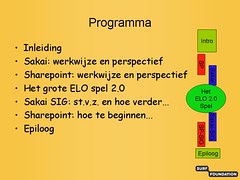
{Dutch} Next wednesday I will be facilitating a workshop (Het grote ELO spel 2.0) for quite a large audience (>75 people are expected). I am doing this together with the community manager for the Sharepoint SIG. We will be focusing on the trends in our society and the impact it has on education, and vice versa.
During the workshop we will be asking the audience to step into another perspective (e.g. adminstrative staff or CIO) and think about the innovative use of ICT from these perspective.

See the SURFfoundation website for more information (in Dutch).

Some questions answered

Updated on April 13. During Peter Bavinck's (Oracle, The Netherlands) talk on April 4, some interesting questions were asked. Peter has been so kind to gather the answers to the questions that were asked on content management, eportfolio and more. The answers will be sent directly by email by Peter to those that had questions.

donderdag, april 12, 2007

What do you think of Sakai conferences?

In case you missed it: there is an intensive and open discussion on when, where and how often Sakai conferences should take place. This is what is so good about Sakai: the open, positive athomospere that shines through in every discussion like these.

woensdag, april 04, 2007

Our meeting was great fun!

Today I had a great day. This was due to the great weather (at least if you were behind windows), but even more to the great meeting we had today with the Sakai SIG NL.
The following institutions were present: University of Amsterdam, University of Twente, Free University, University of Utrecht, University of Applied Sciences of Utrecht, Mondriaan Onderwijsgroep, Saxion University, Hotelschool The Hague and the Leidse Onderwijsinstellingen. Quite an large list, or not?
But not only that, also present were quite a few commercial parties involved in Sakai (in no particular order): Edia, Stoas, Oracle, A New Spring, Portfolio4U and Omix.
I would dare to say that Sakai is quite known in The Netherlands. The next step is that we all start using Sakai!
The concise meeting notes are available at our website. Some photos at Flickr.

dinsdag, april 03, 2007

Sakai and the University of Twente

Just a short note here, especially for those attending our meeting tomorrow that want to know the details of our status. All links in this post will give you information in Dutch, so be warned.
We are approaching the end of our pilots with Sakai at our University. Actually we have started writing our final reports that should be finished by the end of May 2007. It is currently a bit unclear to me what the next steps will be with our reports. What is clear to me is that MS Sharepoint right now is seen as a very serious alternative to Sakai at our University (which was not the case one year ago!).
{Dutch} Als je geïnteresseerd bent in de actuele stand van zaken, lees dan ons statusrapport op onze website.

maandag, april 02, 2007

Reflecting on Innovatium 2007

Last Tuesday the large Innovatium (photos) conference was held in Amsterdam. We were there with a booth (photo after the click). At first I was not so happy with our location. We were upstairs, where none of the action (workshops and presentations) was taking place. But during the lunchbreak people started moving by. Together with Stanley Portier (read his impressions), Frank Benneker and Martine Hilderink we had lots of interesting discussions with the passers-by. We handed out our official flyer, as well as other interesting articles (Morgaine and Wheeler, as mentioned earlier).
There were two conversations that I would like to make note of here. I had a rather interesting conversation with a teacher that was involved in educational projects for and in third world countries (in Africa). His questions were about using Sakai on outdated PC's (should work!) and regarding the bandwidth needed for Sakai on the end-user side (is not so high, not much graphics), as well as the horsepower needed for a server to install and deply Sakai properly (should be OK, you can do it all with opensource software for the whole stack). He already knew quite well that Sakai (but also Moodle) are opensource and therefore free to deploy, which was good to hear! This reminded me of the ITC institution here in Enschede, that has told us that they have some problems with using Blackboard with their partner institutions in the Far East (this kind of use is apparantly not allowed according to the licensing terms).
The other conversation that I found interesting was more a philosophical one: what do we, as an educational institution, really need to offer (with regard to ICT applications) to our students in this Web 2.0 world? Can we not make a proper VLE just by referring the students to stuff like Google (e.g. Gmail, Docs and Groups) and all the free content that is out there. The problem here is, in my opinion, that Google (or other Web 2.0 stuff) is not free in the same way that Sakai is free. There are a lot of restrictions that apply when using Flickr, for example.

vrijdag, maart 30, 2007

Do you kow this weblog?

{This is a little plug for a great weblog} The UBC Arts ISIT Blog is a community blog from the Instructional Development unit at the Faculty of Arts, at the University of British Columbia.

There are some interesting comparisons on Sakai and WebCT on the weblog, as well as some comments and thoughts on Sakai from the standpoint of a teacher. Just go to the weblog to see for yourself. I am curious who the actual writers are on this weblog. Anyone have an idea?


Next meeting: April 4

As you know the conference committee is doing a great job in selecting and reviewing the proposals for the Amsterdam conference. The 'results' will be available shortly.
In the meantime I have everything set up for our 5th meeting of the Sakai SIG NL. It will be held in Utrecht, as usual, at the SURF offices. A detailed agenda (in Dutch) is available. If you haven't received an email regarding this meeting, but are planning to attend, please let me know (so that I can count you in for the lunch!).